

Intuit is cementing its reputation as the ERP provider for the rest of us as it invests heavily in AI, online services and now the midmarket by addressing a full spectrum of requirements from complex revenue recognition and financial reporting to industry-specific billing and project management for hypergrowth firms and their accountants now wanting more out of their QuickBooks.
With improvements in QuickBooks Online Advanced and the two-year-old Intuit Enterprise Suite (IES) for midmarket organizations, Intuit is aiming to expand wallet shares among its core customers as they trade up for more online features like payroll and expense management and embedded capabilities like automated intercompany transactions, while standardizing on Intuit’s intuitive interface, especially for mobile use.
At its recent Las Vegas Intuit Connect event designed for enterprise accounts and prospects, the midmarket push brought together deeper industry applications, migration tools and an expanding accountant channel, with the ambition of keeping customers through their next stage of growth and bringing back businesses that it could have lost to rivals.
CEO Sasan Goodarzi framed Intuit’s strategy around bringing businesses and their accountants onto “one financial system of intelligence.” Intuit Intelligence provides that shared foundation across QuickBooks, IES and Intuit Accountant Suite, combining permissioned financial data with AI, conventional software rules and human expertise. The company’s FY2027 priorities also emphasize roles and permissions, APIs, auditability and performance, which will help determine how well the suite supports more complex businesses.
The enterprise focus is percolating from top to bottom. Earlier this year, Ashley Still, EVP and GM, added the Small Business Group to her existing Mid-Market responsibilities while Wyatt Jenkins, the former Procore chief product officer who joined Intuit in January as SVP of Midmarket Product, is directing the QBO Advanced and IES product development.
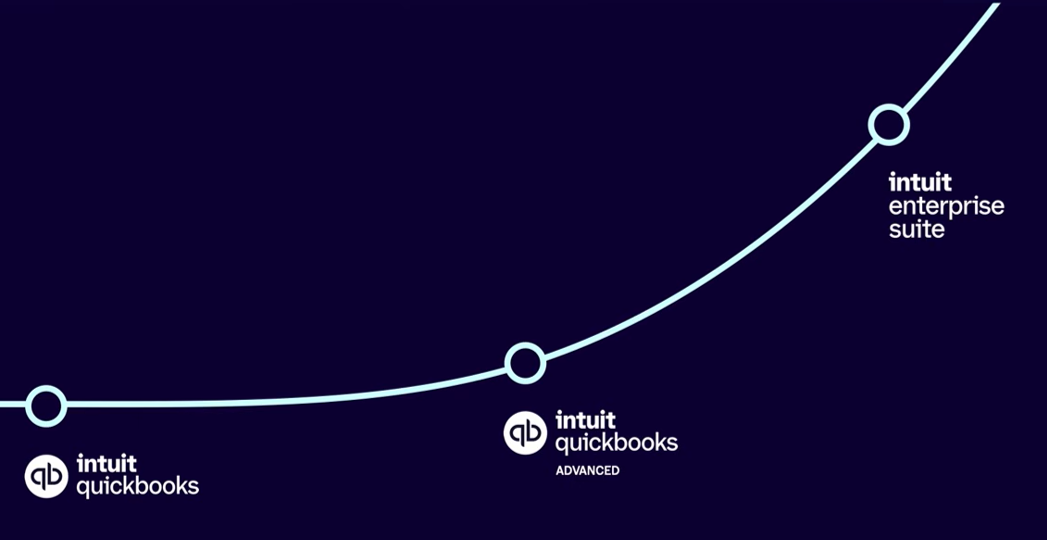
For Still and Jenkins, Quickbooks Advanced and Intuit Enterprise Suite are almost like peas in the same pod. Advanced can retain growing businesses that need stronger reporting, controls and industry workflows while IES addresses more complex requirements, such as intercompany accounting and consolidation across multi-entities.
Together, they give Intuit a clear path to retain and upgrade existing QuickBooks customers as they add subsidiaries, make acquisitions, expand into new markets or need more advanced inventory management, billing and financial reporting enabling their growth within Intuit’s own platform and eliminate their need to switch to other midmarket solutions.
Intuit reported fiscal 2026 midmarket ecosystem revenue of $1.6 billion, up 39%, across QBO Advanced, IES and related services and indirect monetization. The two products ended the year on July 31 with 449,000 paying customers worldwide, up 28%. Roughly three-quarters of additions came from upgrades and Desktop migrations, making expansion within the existing customer base the main source of growth in customer numbers.
Intuit reported approximately $110 million or about 0.6% of its revenues, in AI token spending in fiscal 2026 across internal operations and customer-facing products. Within IES, AI supports account reconciliation, flags financial discrepancies and generates management reports with narrative analysis. These capabilities could help lean finance teams manage more entities and transactions while reducing routine accounting work. For Intuit, the litmus test is whether such AI capabilities deliver consistent improvements in financial accuracy and productivity as customers grow.
CTO Alex Balazs said Intuit draws on 70 AI models, matching each task to the appropriate model and tracking usage, costs and business outcomes. Balazs cited a shift to a less expensive model for internal coding tools that reduced annual costs by tens of millions of dollars with little change in performance. Intuit executives said its AI spend has resulted in savings in product development to the tunes of over $135 million last year.
At its September Investor Day, Intuit identified another 715,000 businesses using QuickBooks Online Core or Desktop as potential upgrades. Average revenue per IES contract for upgrading firms exceeded twice their previous QuickBooks Online spending across all entities. Retaining the accounting relationship as those businesses become more complex gives Intuit a chance to capture a larger share of their spending on software and services.
IES, introduced in September 2024, reached $146 million in annualized revenue at the end of fiscal 2026, about four times the year-earlier level, including accounting, services and indirect monetization. Intuit previously disclosed average revenue per IES contract of $27,000.
Intuit is also expanding its effort to acquire customers beyond the QuickBooks base. Midmarket sales headcount rose 36% in fiscal 2026, while marketing-sourced new-to-the-franchise IES contracts tripled.
Furthermore, Intuit ranked No. 3 in our Top 10 ERP Market report, with an estimated $6.5 billion in ERP applications revenue in 2025, up 14% YoY and a 4.5% share of the worldwide ERP market.
Some of the latest QBO Advanced and Intuit Enterprise Suite (IES) customer wins
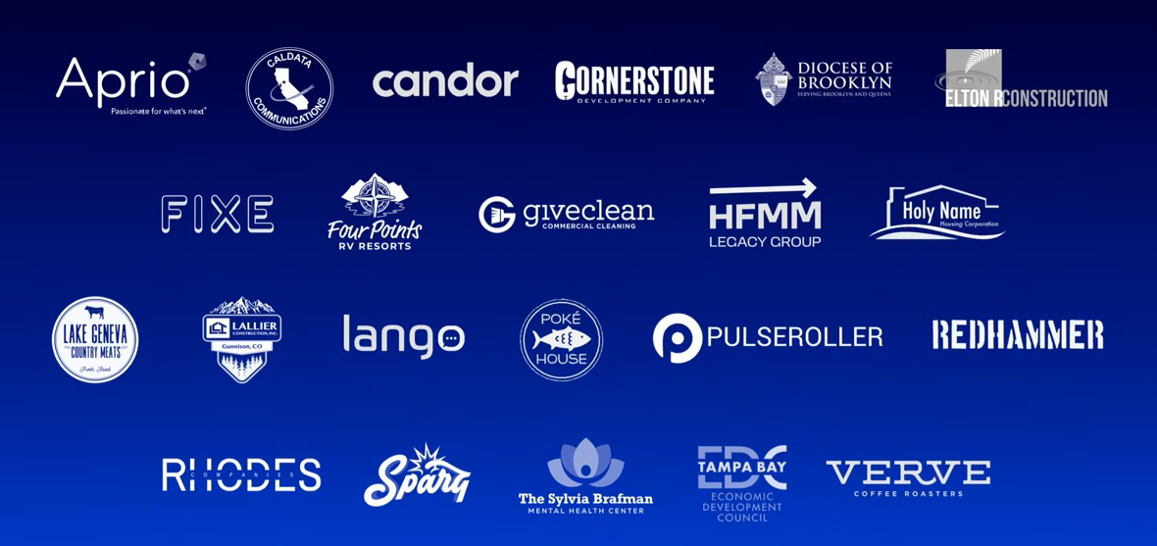
Giving QuickBooks Customers Room to Grow
Rhodes Companies illustrates the opportunity to keep a customer with its evolution. The family office ran multiple instances of QuickBooks Online books requiring its finance team to consolidate manually. It considered many other ERP brands before choosing IES and reported cutting its monthly close from 10 days to five. “We have nine sets of books and leadership loves the ability to pull them all up in five minutes,” said CFO Caleb McDaniels.
Landtech Resources, a surveying and engineering firm, moved from QuickBooks Desktop Enterprise to Advanced on its accountant’s recommendation, reporting that more than 25 years of company-file history transferred over a weekend. Its choice shows how Advanced can facilitate a substantial Desktop migration without requiring the customer to adopt IES.
Cornerstone Development Company, the construction and engineering group with 70+ employees, moved from QuickBooks Advanced to IES to manage five entities through a shared chart of accounts, automated intercompany transactions and consolidated reporting. Cornerstone reported a 50% reduction in month-end closing time, adopting of AI features and lower external CPA audit costs. The upgrade gave the company a way to support its expanding operations while keeping its ERP within the Intuit platform.
Verve Coffee Roasters offers another example of Intuit retaining a customer during an ERP evaluation. With three QuickBooks Desktop files and a growing wholesale and café business, Verve evaluated different options before selecting IES. The switch to IES enabled faster payment and check runs by at least 50%. Like Rhodes, it shows Intuit defending the customer relationship when a rival becomes a credible option.
To win more customers from competing vendors, Intuit will need to help businesses move their financial data and adapt their accounting workflows. At Connect, Intuit outlined migration tools for NetSuite and Sage that were in pilot. Another ace in its pocket is its heavy investment in an attractive mobile interface that has won accolades even from some of its rivals.
Intuit reported that 22 of the 38 most-requested Desktop features were available across Advanced and/or IES, including some in beta or limited to IES. Another 16 were forthcoming. Bills of materials, serial-number tracking, payroll corrections and invoice layouts may determine whether a company can move its daily operations as readily as its accounting records.
Construction shows how Intuit is building the industry capabilities needed to retain fast growing QuickBooks customers. QBO Advanced supports project budgets, change orders and work-in-progress reporting, while IES adds more specialized billing tools for commercial contractors. These include schedules of values, pay applications and retainage management, which Intuit lists as beta in its November release overview. By connecting project progress and contract terms to invoicing, these tools help finance teams track what they can bill, what customers owe and which payments remain held back until contract requirements are met.
The nonprofit offering follows a similar progression, from tracking donor restrictions and reporting on funds to grant management and consolidation across entities. At Connect, the nonprofit and manufacturing editions were shown in pilot, followed by upcoming releases for healthcare and field services.
Elsewhere, the Manufacturing edition covers multi-location inventory, pick-pack-ship and multilevel bills of materials. Individual capabilities are moving at different speeds, with the listing inventory management as generally available and multicurrency in beta for eligible US-based entities consolidating in US dollars.
Recently Intuit acquired Sequence to support its push into midmarket ERP with capabilities spanning deal configuration, pricing, billing, collections and revenue recognition. Advanced revenue recognition was among the requirements Intuit cited at Connect as a reason customers leave QuickBooks, making the acquisition directly relevant to its retention and win-back strategy. Integrating Sequence into IES could help Intuit support more complex customer contracts and give finance teams greater visibility into future billings and cash flow.
Accountants Extend the Midmarket Reach
Accounting firms funnel business to Intuit like no other. More than 70% of Advanced and IES customers work with an external accountant and accounting practices drove a quarter of new IES contracts in fiscal 2026. Aprio, which supports QuickBooks-to-IES implementations and ongoing advisory work, expanded its Intuit partnership to develop AI tools for those services.
Firm Playbooks and portfolio intelligence in Intuit Accountant Suite (IAS), both in beta, are designed to standardize onboarding and workflows and surface patterns across a firm’s client base. The Agent Studio pilot lets firms build agents once, deploy them across clients and monitor their performance. For Intuit, helping an accountant repeat an implementation or advisory service could extend its reach beyond what its own sales team can support, that could potentially lead to an Intuit Marketplace in 2027.
Intuit is also extending IES beyond accounting through Workforce Elite, an optional offering that combines HR, time tracking and payroll. Its capabilities cover hiring, onboarding and employee management, while connecting hours worked and payroll costs to financial reporting across entities and projects. For construction and other labor-intensive businesses, that connection can give finance teams a clearer view of how staffing and overtime affect project margins. It also gives Intuit another opportunity to retain growing customers by supporting their workforce’s needs alongside their financial operations.
Based on testimonials and interviews with customers and partners, Intuit has a good shot with its midmarket push. The question is not whether Intuit is committed to large enterprises, but rather the delicate balance it needs to strike by ensuring that its small business customers are equally well-served as the enterprise, while ratcheting up its pressures on partners and rivals alike that the world of ERP suite in the age of AI is about to change quickly.
Intuit Enterprise Suite and QuickBooks Advanced Customer Wins
| Customer | Application | Reported benefit |
|---|---|---|
| Landtech Resources | QuickBooks Desktop Enterprise to QuickBooks Online Advanced | More than 25 years of company-file history moved over a weekend. |
| Rhodes Companies | IES, replacing nine separate QuickBooks Online books | Monthly close shortened from ten days to five. |
| Verve Coffee Roasters | QuickBooks Desktop to IES, selected after evaluating NetSuite | Payment and check runs at least 50% faster. |
| Elton R Construction | QuickBooks Desktop to IES | Closed fiscal 2025 at the end of January 2026, three months earlier than the previous year’s close. |
| Cornerstone Development Company | QuickBooks Advanced to IES | 50% reduction in month-end closing time. |
