

Oracle is stepping up the release of ready-to-deploy Fusion Agentic Applications that aim to help enterprise users ascertain whether and how a full spectrum of corporate functions from finance to sales should be automated.
Certainty is the key as Oracle is putting together a double passageway to mitigate the risks, while giving customers discretion, control as well as the increased possibility of achieving the desirable outcomes with their Oracle Fusion Applications investments.
Oracle Fusion Claw is the new governed enterprise agentic execution runtime that powers a growing library of Fusion Agentic Applications. The approach combines AI reasoning for planning and adaptation with deterministic enterprise computation for precise execution at scale.
Oracle Fusion Claw runs on Oracle Cloud Infrastructure and is powered by frontier models including Google Gemini and OpenAI.
The introductions follow a 14% rise in its Fusion Back-Office Applications revenues in its latest quarter ended in August 2026 to reach a record $1.6 billion, underscoring their growing momentum.
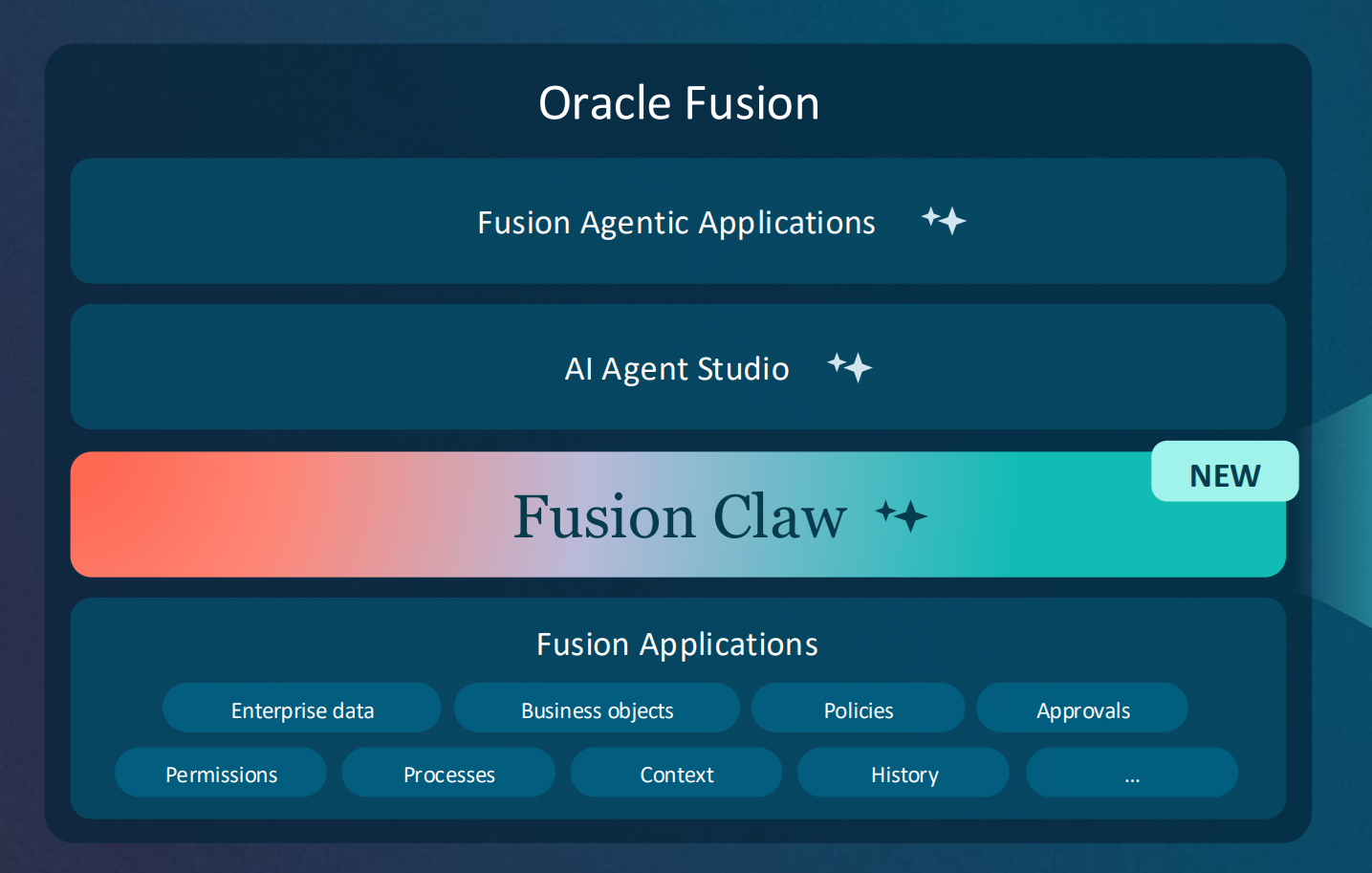
With the Oracle Fusion Applications portfolio becoming more entrenched among its installed base, Fusion Claw pushes the envelope further by venturing into more sophisticated planning and execution that can analyze alternatives, develop a plan and, when delegated authority permits, carry that plan into governed action.
To paraphrase Chris Leone, EVP of Applications Development at Oracle, Fusion Claw facilitates big picture planning and more complex enterprise execution while people continue to define outcomes, boundaries and authority and remain accountable. Fusion Agentic Applications own the process, while Fusion Claw runs the enterprise execution.
With AI safety becoming a divisive issue that could impede its growth, Oracle’s approach is to bring more transparency to a new technology that sometimes raises more questions than answers.
Oracle CEO Mike Sicilia said by letting AI take on more of the work, while people set the objectives and guardrails, organizations can unlock tremendous capacity for their teams to focus more on growth.
As AI agents are becoming sophisticated enough to reason, compute, adapt, and execute domain-specific work including deep research, computation, simulation, modeling, and continuous re-planning, the challenge is to ensure that any forthcoming action stays within the authority the enterprise has delegated. If the action is within authority, the agentic application will execute; when approval is required, it will seek approval.
Case in point is the Ledger Agentic Application that allows accountants to quickly comb through massive amount of journal entries for reconciliation and detection of anomalies, a task that could have taken a team of finance analysts days or weeks to finish in the past. That’s the first entryway.
An execution layer, or the second entryway into the inner sanctum, comes into view with Oracle unveiling Enterprise Operating Envelope, which includes an organization’s objectives, standard operating procedures, policies, constraints, permissions, risk thresholds, decision rights, approval requirements, and escalation boundaries. Fusion Claw’s Outcome Trust Harness turns that envelope into enforceable runtime controls.
Other Fusion Claw-powered agentic applications are designed to handle such tasks as workforce staffing across skills, availability, scheduling, labor rules compliance, costing and service requirements, all of which can be analyzed and acted on according to the authority delegated in the Enterprise Operating Envelope.
A new Fusion Claw-powered Agentic Application for Shipping Consolidation is another example of putting such governed execution system in place – with the Agentic Application owning the process and Claw modeling alternatives across shipping constraints, optimizing the plan and either preparing it for review or carrying it into execution when delegated authority permits. Manifesting sales force automation from the get-go, Fusion Claw-powered Agentic Applications could be used to develop effective territory plans on-the-fly by continuously measuring against constraints or making adjustments based on account dynamics and incentives by modeling alternatives, comparing scenarios and optimizing territory plans within enterprise-defined constraints and authority.
