

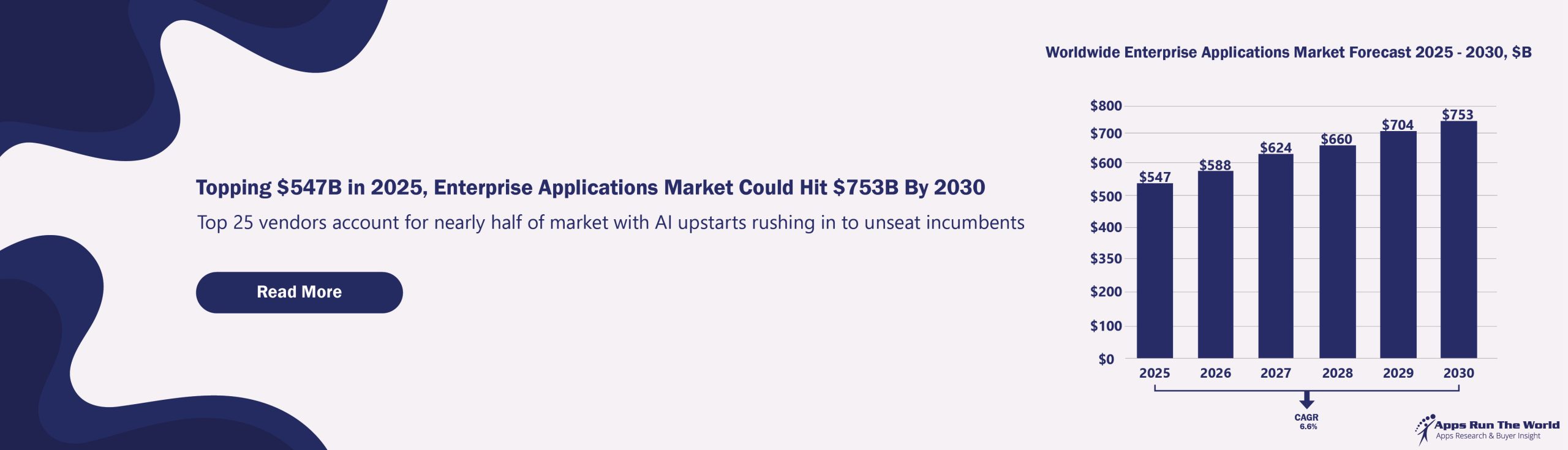
The worldwide enterprise applications market crossed half a trillion dollars in 2025, an important milestone attributable to the concerted efforts of thousands of Cloud and on-premise vendors that now find themselves charting an uncertain future compounded by the newfound powers of AI upstarts and structural changes to the software industry itself.
Last year, the enterprise applications market posted $547 billion in software revenues, a 11.9% rise fueled by the meteoric rise of AI vendors including OpenAI and Anthropic that have parlayed their successes in AI modeling to content management, specifically for paid search with their AI prompts and recommendations geared toward enterprise workflows for everything from AP automation to customer support.
As shown in the following exhibit, the enterprise applications market is dominated by tech giants like Microsoft, Salesforce, SAP, Oracle and Adobe, which collectively account for 28% of total revenues. Eighteen of the top 25 vendors saw double-digit increases or more with Anthropic and OpenAI zooming to be among the biggest enterprise applications providers in 2025 after clocking in triple-digit growth rates.
Exhibit 1 – Top 25 Enterprise Applications Vendors Worldwide and Their 2024-2025 Revenues, and 2025 Market Shares, %
| 2025 Software Revenues, $M | 2024 Software Revenues, $M | Change YoY | 2025 Market Share, % | |
|---|---|---|---|---|
| Microsoft | $56,978 | $52,382 | 8.8% | 10.4% |
| Salesforce | $30,562 | $27,626 | 10.6% | 5.6% |
| SAP | $25,648 | $22,744 | 12.8% | 4.7% |
| Oracle | $20,544 | $18,081 | 13.6% | 3.8% |
| Adobe | $19,609 | $17,634 | 11.2% | 3.6% |
| ServiceNow | $11,220 | $9,271 | 21.0% | 2.0% |
| $8,862 | $7,700 | 15.1% | 1.6% | |
| Workday | $8,836 | $7,718 | 14.5% | 1.6% |
| Intuit | $8,474 | $7,491 | 13.1% | 1.5% |
| Constellation Software | $7,621 | $6,580 | 15.8% | 1.4% |
| Dassault Systemes | $6,382 | $6,082 | 4.9% | 1.2% |
| Autodesk | $6,125 | $5,168 | 18.5% | 1.1% |
| OpenAI | $5,882 | $1,480 | 297.4% | 1.1% |
| Synopsys | $4,691 | $3,462 | 35.5% | 0.9% |
| UKG | $4,532 | $4,245 | 6.8% | 0.8% |
| Atlassian | $4,276 | $3,531 | 21.1% | 0.8% |
| Roper Technologies | $4,239 | $3,635 | 16.6% | 0.8% |
| Zoom Communications | $4,221 | $4,045 | 4.4% | 0.8% |
| Anthropic | $4,000 | $396 | 910.1% | 0.7% |
| Siemens Digital Industries Software | $3,437 | $3,364 | 2.2% | 0.6% |
| FIS | $3,278 | $3,139 | 4.4% | 0.6% |
| DocuSign | $3,080 | $2,901 | 6.2% | 0.6% |
| HubSpot | $3,068 | $2,570 | 19.4% | 0.6% |
| Sage | $3,055 | $2,769 | 10.3% | 0.6% |
| Cadence Design Systems | $3,025 | $2,715 | 11.4% | 0.6% |
| Subtotal | $261,645 | $226,729 | 15.4% | 47.8% |
| Other | $285,977 | $262,694 | 8.9% | 52.2% |
| Total | $547,621 | $489,423 | 11.9% | 100.0% |
In 2025, Microsoft continued to lead the pack with its Microsoft 365 cash cow. Specifically, the Microsoft 365 Commercial product for office productivity accounts for more than half of its enterprise applications revenues based on mapping of Microsoft’s reported revenues to our taxonomy, as shown in the following exhibit.
The following exhibit shows the 2025 model for Microsoft’s enterprise applications revenues.
Exhibit 2 – Mapping Microsoft’s Enterprise Applications Products and Revenues to ARTW Taxonomy, $M
| Microsoft Products | 2025 Revenues, $M | ARTW Correponding Markets |
|---|---|---|
| 365 Commercial | $29,000 | Content Management |
| Dynamics Products and Cloud Services | $7,827 | ERP and CRM |
| $5,000 | HCM | |
| 365 Commercial Onpremise | $3,967 | Content Management |
| Microsoft Teams | $3,600 | Collaboration |
| Copilot | $2,500 | Collaboration |
| Power BI | $2,360 | Analytics |
| Other(SharePoint, UCC) | $1,474 | Collaboration |
| Other(Nuance, Orions System, Xandr, Microsoft Viva, others) | $1,250 | HCM and Other |
| Total | $56,978 | |
| Non Enterprise Applications Revenues* | $63,832 | |
| Microsoft’s Reported Revenues for Productivity and Business Processes | $120,810 | |
| *Non Enterprise Applications Revenues Include the Following: | ||
| Office Consumer | ||
| 365 Commercial Onpremise Reported Under Server Licensing Pre-Recast | ||
| 365 Consumer OnPremise | ||
| Cloud versions of Windows Commercial | ||
| Enterprise Mobility and Security | ||
| Exchange | ||
| LinkedIn Subscriptions | ||
| Windows OnPremise |
While Microsoft has made the habit of defining Productivity and Business Processes and now Microsoft 365 Cloud to include many different products other than Microsoft 365 Commercial, the Microsoft model that we use is based on historical revenues of only the Office 365 suite for business customers over the past decade.
Another reason that we place a conservative estimate on Microsoft’s enterprise applications revenues below those of the reported Microsoft 365 Cloud revenues – or for that matter its 2025 sales increases, has to do with the seat growth of Microsoft 365 Commercial, which has advanced no more than 7% over the past eight quarters. Additionally, the vendor’s reclassification of revenue by product – twice over the past two years – suggests that the only consistent way to track the pace of Microsoft 365 Commercial is to retrace its steps back to 2017 when the product was a little over $10 billion in revenue and rising on average at around 13.5% annually through its fiscal 2026.
By comparison, Microsoft reported revenues of Office Products and Cloud Services grew on average at 12% annually between fiscal 2017 and fiscal 2023. The vendor in the following year recast those revenues, resulting in a 58% jump without providing any explanation for the spike.
The upshot is that Copilot, introduced in 2023, is showing tangible progress with Microsoft revealing at least 30 million paid seats for the agent. Our estimate shows that Copilot is generating as much as $2.5 billion in incremental revenues for Microsoft at a time when the overall sales of Microsoft 365 Commercial could plateau because of shifting demographics with more baby boomers retiring, one of the biggest contingents of knowledge workers that have helped sustain the use of Office productivity tools for decades. Newer workers, accustomed to using mobile phones for everyday communication, are not necessarily skipping Microsoft 365, but they are not beholden to the PC form factor either.
Another obstacle Microsoft faces is potential market saturation. By targeting a billion knowledge workers worldwide, Microsoft 365 cannot afford to lose any of them to new tools like AI and agents, which could render the traditional use of Excel or Powerpoint obsolete. Hence, the future of Microsoft’s enterprise applications strategy could hinge on how effective it can use Coplilot to mitigate any possible decline in the use of Microsoft 365.
Performance of the remaining 1,471 vendors underscores a market divided into the haves and have nots. Direct interactions with these 1,471 vendors are part of our annual survey conducted continuously since 2010 for this study and similar market-sizing reports.
(Our annual survey of these 1,472 enterprise applications vendors resulted in dedicated profiles of each and everyone of these providers with specific emphasis on their historical revenues by revenue type, product, functional market, industry, country and direct vs indirect channels. Following feedback from these vendors, their financial results form the basis of hundreds of market-sizing reports that we have been updating continuously since 2010. The performance of these vendors and their corresponding markets is further augmented by supplemental findings derived from the most recent customer wins of more than 20,000+ other enterprise software vendors in our Buyer Insight Technographic Database to quantify their market presence by product, geography and industry.)
Without the contributions from OpenAI, Anthropic and many other fast-growing vendors like Palantir(which has benefited from its close ties with government accounts) that have taken full advantage of the automation euphoria with their own rendition of AI-powered applications, the enterprise applications market would have posted a high single-digit growth rate at best last year.
Forecast of Enterprise Applications Market Through 2030
Even the high single-digit gain could have been offset by a rash of mergers and acquisitions between 2025 and 2026. Other factors such as AI backlash and macroeconomic concerns could also present constraints for the enterprise applications market to post solid gains year after year, in addition to a number of key assumptions listed below.
Moreover, the troubles brewing among many PE firms that have large stakes in enterprise software companies could spill over to institutional investors, forcing them to lower their exposure to tech.
Then, there is the issue of attrition as users of Cloud applications are beginning to be less engaged with their systems, many of which have been developed as good enough, but never fool-proof, unlike the fault-tolerant and resilient nature of client-server or even mainframe applications. With the advent of AI that is being supported by a whole new generation of gigawatt data centers now coming online all over the world, good enough applications may no longer be good enough for today’s savvy users that are going to be more demanding than ever because they or their agents could switch things at a moment’s notice.
Currently, our forecast for the enterprise applications market shows a 6.6% CAGR through 2030 with projections reaching $754 billion as shown in the exhibit below.
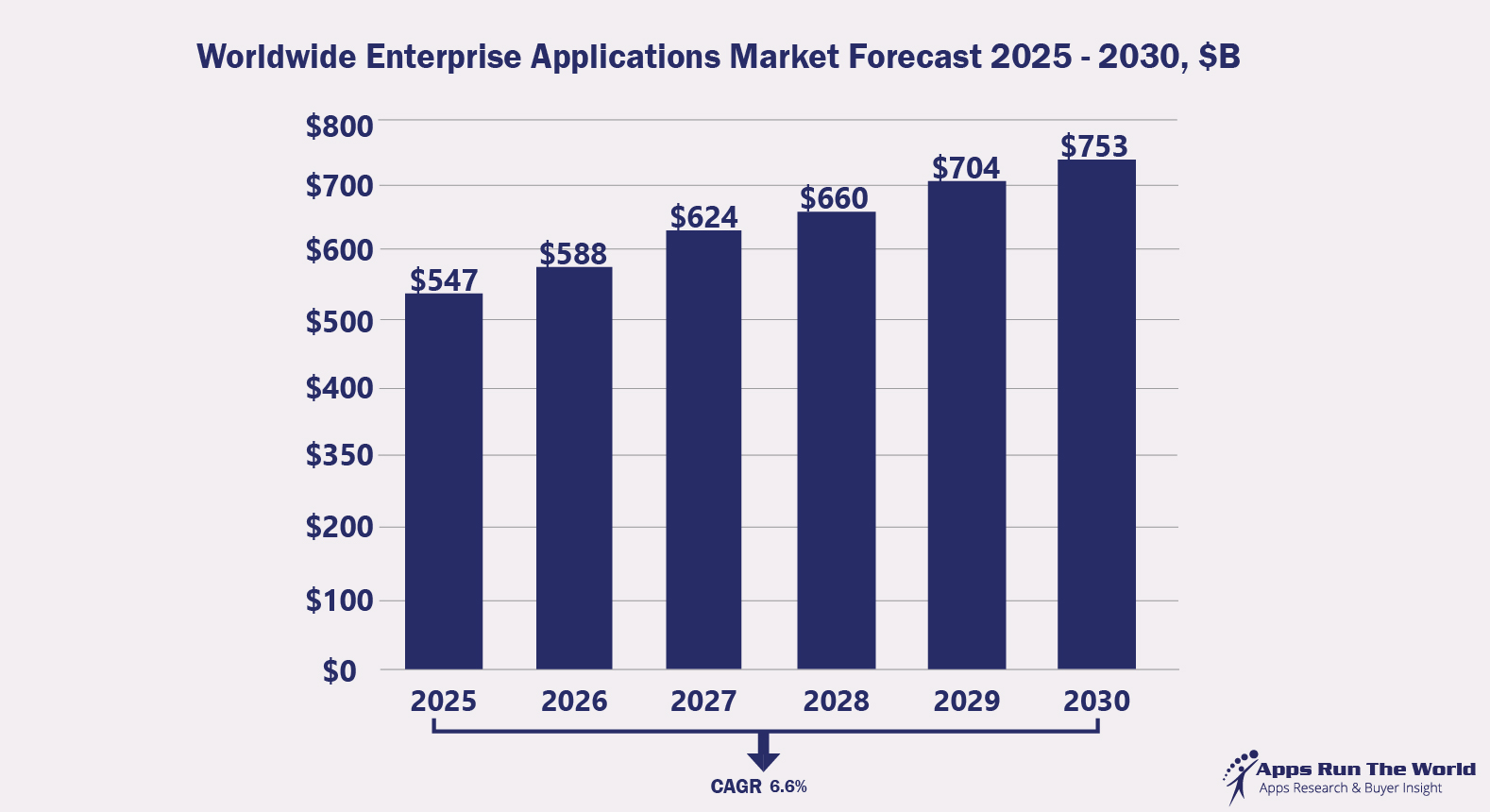
Exhibit 3 – Worldwide Enterprise Applications Market Forecast Through 2030, $M
| 2025 | 2026 | 2027 | 2028 | 2029 | 2030 | CAGR |
|---|---|---|---|---|---|---|
| $547,621 | $588,267 | $624,115 | $660,007 | $704,125 | $753,565 | 6.60% |
FORECAST ASSUMPTIONS
Shakeout starts spreading
In the tech industry, any merger has not been particularly conducive to organic growth, but the lure of growing big has not prevented many from doing so.
ServiceNow, for example, has paid more than $11 billion over the past few quarters for a number of AI and analytics vendors including Armis, Moveworks and Veza.
Roper Technologies, on the other hand, is aiming to spend at least $5 billion on new acquisitions over the next 12 to 18 months. Serial acquirer CSI Software has already spent a record of $1.6 billion in 4Q25 and 1QFY26 on a number of outright purchases or stakes in vendors like Sabre and Asseco. Similarly, Bending Spoons has recently bought Airtable and Miro for $2.6 billion at fire sale prices.
Other notable deals in 2025/2026 included the $35-billion Ansys purchase by Synopsys, the $8.4-billion Smartsheet purchase by Blackstone and Vista Equity Partners, the $12.3-billion Dayforce purchase by Thoma Bravo, the $6.4-billion OneStream purchase by Hg Capital, the $8-billion purchase of Informatica by Salesforce, and more recently the $13-billion Hugging Face purchase by Nvidia and the $60-billion Cursor purchase by Xai.
With few exceptions, enterprise applications vendors that got acquired in recent quarters were sold on the cheap. Miro with its collaboration applications had been valued at $17.5 billion before Bending Spoons picked it up for $1.36 billion. HR apps vendor Dayforce reached an all-time high at $130 per share in November 2021 and it was sold to Thoma Bravo for $70 apiece in February 2026.
Then there was the November 2025 bankruptcy of Anthology in the edtech space, which has spawned Blackboard after a recapitalization as well as the sale of Anthology’s student information system business to Ellucian.
Anthology’s fall from grace is a good example of legacy applications vendors failing to respond to market changes, ceding control and wallet shares of its customers to more nimble players like OpenSIS and Scout that have been able to capitalize on their AI-powered student information system.
That kind of disparity is becoming a recurring theme.
For example, Tyler Tech for public sector organizations was able to post a respectable 11% uptake in 2025. That pales in comparison to the 35% jump in enterprise applications revenues Via Transportation was able to achieve in the same period with its public transit applications. Via recently acquired Knode.ai to fuel its expansion.
The same applies to Ramp Business Corporation for AI spend management, which saw a 64% jump in enterprise applications revenues to reach $660 million in 2025. One of Ramp’s latest offerings is to enable companies to track and control their AI token expenditures.
On the other hand, one of Ramp’s primary competitors is Coupa, which positions itself as an AI-native Spend Management vendor that does not offer an AI token spend management tool. Coupa, which has recently seen the abrupt departure of its CEO in August 2026 and is now led by a Thoma Bravo partner, managed to boost its enterprise applications revenues by only 7.6% to reach $800 million in 2025.
Coupa was founded in 2006 and Ramp was founded in 2019 and one can even argue that the former is an emblem of the turbo-charged SaaS era a decade earlier, while the latter is capable of adapting to the AI era on a real-time basis. Similarly, HiBob, founded in 2015, is now considered one of the fastest-growing HCM vendors, more than doubling its software revenues in 2025 to $130 million. Recently, HiBob received a $166 million in new funding from Salesforce and other investors.
In the legal vertical, Clio, founded in 2008, has debunked the myth that AI upstarts are beginning to cannibalize conventional legal practice management systems. Last year, Clio more than doubled its software revenues to $270 million after buying legal database provider vLex for $1 billion in November 2025, in addition to receiving a $500 million new funding from New Enterprise Associates.
Lensing, formerly Everest System, bagged $140 million in new funding recently as it starts laying the groundwork as an AI-powered alternative to legacy ERP providers from SAP to Oracle.
What it boils down to is the fact that the script – or the same demand for careful but swift execution – is playing out all over again when many onpremise enterprise applications vendors failed to adapt to the cloud and lost shares to SaaS providers precipitously since 2000. This time the rules of the game have changed though.
Applications boundaries are blurring
The rise of AI has certainly caused many applications vendors to lose their luster. For one thing, some customers are now vibe-coding to their teeth and replacing their enterprise applications from customer support to project management with their own AI systems.
Another development worth watching is the weeding out of the weaker players in the enterprise applications market could usher in a wave of super apps. For instance, ServiceNow, following its dominance in the IT Service Management market, is aiming to expand into anything an IT department touches. This amounts to a clarion call for the vendor to encroach on any adjacent market it sees fit.
Also, the proliferation of agents could relegate some applications to a lesser role. After all, if an agent is smart enough to automate production planning, why keep using a dedicated production planning system?
The crux of the issue is whether anyone wants to replace a system of record with something that is not fully vetted but still requires perpetual support and maintenance.
Similar to the shift from onpremise to the cloud, there will be a transition period for any organization to tinker with AI and agents to see if the results meet their expectations. The question is how much time they have to make that adjustment when Frontier AI labs and upstarts are banging on their doors urging them to reprioritize their applications strategies.
Another scenario is what SAP President and Chief Product Officer Manoj Swaminathan refers to as agent-led migration – meaning if agents are becoming powerful enough to interact with SAP and non-SAP systems through integration tools like MCP, they too can detect the weaker links and by doing so customers would want to standardize everything back to SAP because it remains their system of record.
Our assumption is that customers are likely to take a more deliberate approach by spreading their risks and insisting that their system integration partners should be in a good position to be the arbiter of agentic capabilities when determining which systems should be kept and others to be ditched.
Cost, value divergence exacerbates ambiguity
At a time when the cost and value equation of enterprise applications is diverging makes the job of any CXO more difficult when deciding the true cost of software and its value, or for that matter how many AI tokens they should budget for.
First, software prices are rising as witnessed by double-digit price hikes of many Microsoft 365 packages in July 2026. Then, use of agents on top of many enterprise applications will incur additional fees, something that Oracle, Salesforce and others are implementing after years of including AI functionality for free or next to nothing early on to entice first movers.
The value equation is more ambiguous. While Frontier AI labs tout the fact that they can model a staggering amount of data mankind has ever created, the value they place on one dataset to another is almost indistinguishable. In other words, the first rule of summarizing the datasets is to treat them equally. The hard part is does it have the domain expertise to discern what part of information is more valuable than others and to whom. Another scenario calls for using an AI model to spit out 10 massive reports in an hour, all of which would require hours or even days of manual work for a decision maker to sift through them and determine if any of these reports is worth repurposing or generating in the first place.
In an age of hyperinflation, heavy debt loads and high interest payments, the impending shakeout in the enterprise applications market that is going to impact many vendors – not to mention their investors including some of the biggest PE firms in the world – will lead to drastic cuts for customer support. Increasingly one has to pay more for software, but the support – or the intrinsic value – that comes with it may fall by the wayside.
An example of the divergence is the Bending Spoons’ formula of buying software assets, stripping out their overhead and making rapid changes to how these applications and their features would be enhanced or discarded depending on how many new customers including freemium users are being added as if the store hours would be automatically adjusted based on how much traffic it gets. Case in point: after buying AOL, Eventbrite and Vimeo in late 2025, Bending Spoons quickly reduced headcount at these operations from 1,830 to a few hundred remaining in 2026, according to its IPO filings.
Bending Spoons’ approach is nothing new. The same kind of cuts are happening at Broadcom following its purchase of VMware and similarly at Citrx, Tibco and others held by Cloud Software Group, drawing widespread customer complaints as evidenced by their online postings.
It’s worth asking what value the customers are getting in the face of such steep cuts and whether such sharp turns would allow them to run these applications with certainty.
