

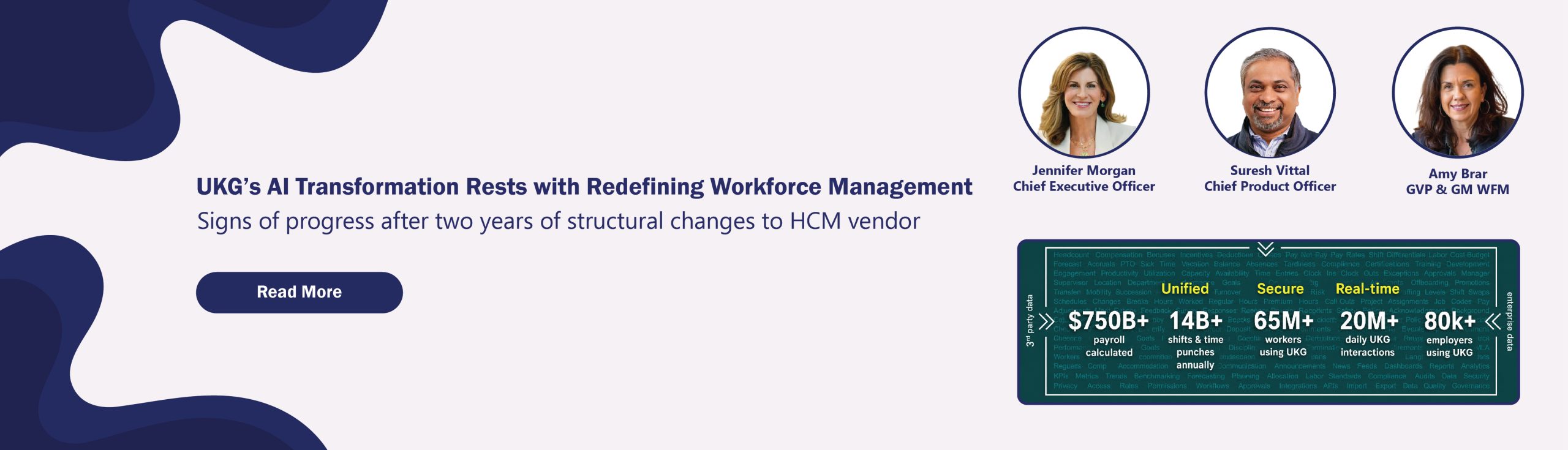
Almost two years after a new management team stepped in to overhaul UKG, there are signs that the No. 1 workforce management software company is entering its final stretch of its transformation, perhaps rewriting the rules of the game along the way.
At a recent analyst briefing, Jennifer Morgan, CEO of UKG, said the vendor has assembled all the components to deliver a connected system that covers HR, Pay and Workforce Management with the support of a robust data platform.
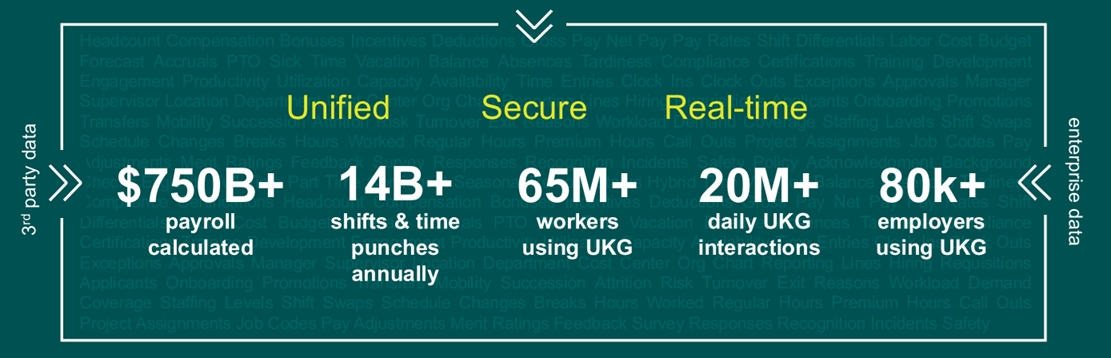
“We are redefining the workforce management category,’’ Morgan said, adding that UKG People Fabric, which encompasses billions of datasets for time punches annually and three quarters of a trillion dollars in payroll calculations, as well as mountains of talent management transactions, now serves as the foundation for current and future extensions of AI agents all trained after the UKG Workforce Intelligence Hub with the backing of its long-time partner Google and its Gemini AI assistants.
In recent quarters, by making available to its 80,000+ direct and indirect customers an increasing number of digital agents, many of which are initiated via conversational interface, Morgan proffers that it is capable of making work effortless for tens of millions of frontline workers that depend on UKG apps to schedule shifts, request time off, receive paychecks, while conducting a whole host of HR tasks before, during and after they are hired and retire.
Since becoming the CEO in July 2024, Morgan has assembled a squadron of product, sales, services, marketing, and communications leaders with 80% of her immediate reports being new to the vendor.
The heart of UKG’s own transformation mirrors the changes that are shaping the overall enterprise software market with the growing belief that the power of AI is turning upside down commonly-used modules, codes, business logic, presentation layers, rules engines, processes and workflows, all of which are at the mercy of prompts, inferences, outcomes, and real-time results made available by frontier AI labs.
Data Difference
Suresh Vittal, chief product officer of UKG, said what UKG is good at over the past decades – amassing and harnessing insights from massive amounts of trusted and verifiable workforce data generated and updated regularly by 65 million workers worldwide – now represents its competitive data advantage.
For example, Workforce Intelligence Hub, the building block of its operating system for hiring, training, scheduling, clocking, compensating, and measuring workers and their contributions, is attributable to the on-the-fly creation of AI apps, assistants, and solutions that have delivered tangible results for its early AI adopters to the tunes of double-digit performance improvements in the forms of fewer unfilled shifts, shorter time to hire, reduced HR tickets and shorter payroll processing.
“More workforce signals than anyone else powers better AI,’’ notes Vittal.
Corey Spencer, UKG general manager of AI and Platform, said one early adopter of these Job Genius and Interview Guide agents has saved 40 hours per week on recruiting.
Other use cases of Workforce Intelligence Hub, Spencer added, include extrapolating reliable labor costs on a moment’s notice and synthesizing industry-specific trends that are not visible to anyone except UKG because its products have been widely used across different verticals from retail to construction. Case in point is the ongoing shortage of skilled construction workers exacerbated by the massive data center buildout under way in many parts of the country.
Expounding upon the unique value of its data, Amy Brar, UKG group vice president and general manager of Workforce Management, said the release of Dynamic Workforce Operations, which is served up by agents for real-time guidance and recommendations easily extensible at the granular level to determine ad-hoc scheduling and shift coverage needs, will help companies better handle intraday changes in demand along with tackling other compliance and productivity issues.
Pricing Changes
As UKG rolls out measures large and small to redefine workforce management for the long haul, it has also started transitioning to usage and consumption-based pricing. Company executives plan next to release so-called action packs to complement its data products akin to token-based pricing by other AI companies.
To do that, UKG is bullet-proofing its value chain up and down the market. With its acquisition of Inova in December 2025, UKG now offers payroll support for organizations with fewer than 75 employees. Already processing payroll for millions of workers worldwide with its UKG One View product, UKG has helped many SMBs automate the repetitive task to perfection with one 120-employee manufacturer citing the reduced amount of time to process payroll from four hours to seven minutes.
Another measure is the creation of the Frontline Worker Network, a new version of anticipating and meeting the financial wellness and physical wellness needs of employees of employees using AI and trend data from within the platform. Along the same theme of making work processes effortless for frontline workers, its HR Service Delivery product, which covers a range of document support and services like PeopleAssist for HR service ticket resolutions, can be extended to SAP Successfactors, Workday and Oracle Core HR applications. ServiceNow can be easily integrated into UKG for rapid offboarding processes like return of IT equipment, along with the use of SharePoint for employee portal communications as a companion piece especially for those that have extensive use of Microsoft tools.
UKG’s Action Items
Despite a series of personnel changes including a recent restructuring that UKG has experienced since 2025, the tough climb of this long race is still ahead, and these are the action items awaiting UKG employees and its customers.
First, while UKG has tinkered with its pricing strategy, it is not ready for outcome-based metrics, something that customers are increasingly demanding from their enterprise software providers. For that matter, that extends to any vendor given the relationship between a customer and its technology provider is increasingly governed by token usage, similar to how users view utilities and what buyers can do to mitigate price volatility and quickly switch to other options if necessary. Demonstrating UKG’s value propositions through the lenses of predictable outcomes may well be its ultimate proof point.
Second, when plotting and executing at lightning speed, UKG must give time to its employees and customers to reflect upon what is working and what’s not. While change is constant and nonstop, reflection is the context that may well be the key to differentiating UKG from others that are trying to accelerate and execute at the speeds of AI at all costs.
Third, making work effortless is a tall order in the age of AI. The secret may lie in eliminating the complexity for the customer. One should give credit to UKG for focusing on value-based outcomes instead of promoting a variety of different agents that handle tasks of varying complexity.
