

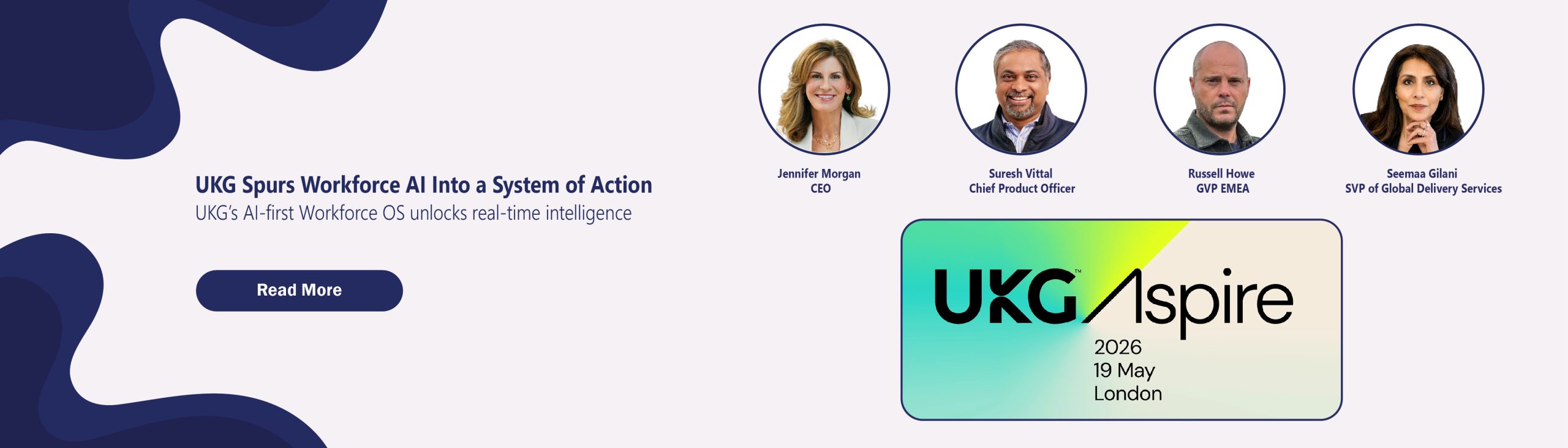
With decades of domain expertise and heavy R&D investments in workforce management, UKG is steering the AI conversation beyond digital agents and workflow automation to a more practical question: whether AI can help organizations automate the Core HR function in real time without compromising trust, pay accuracy, compliance or employee experience.
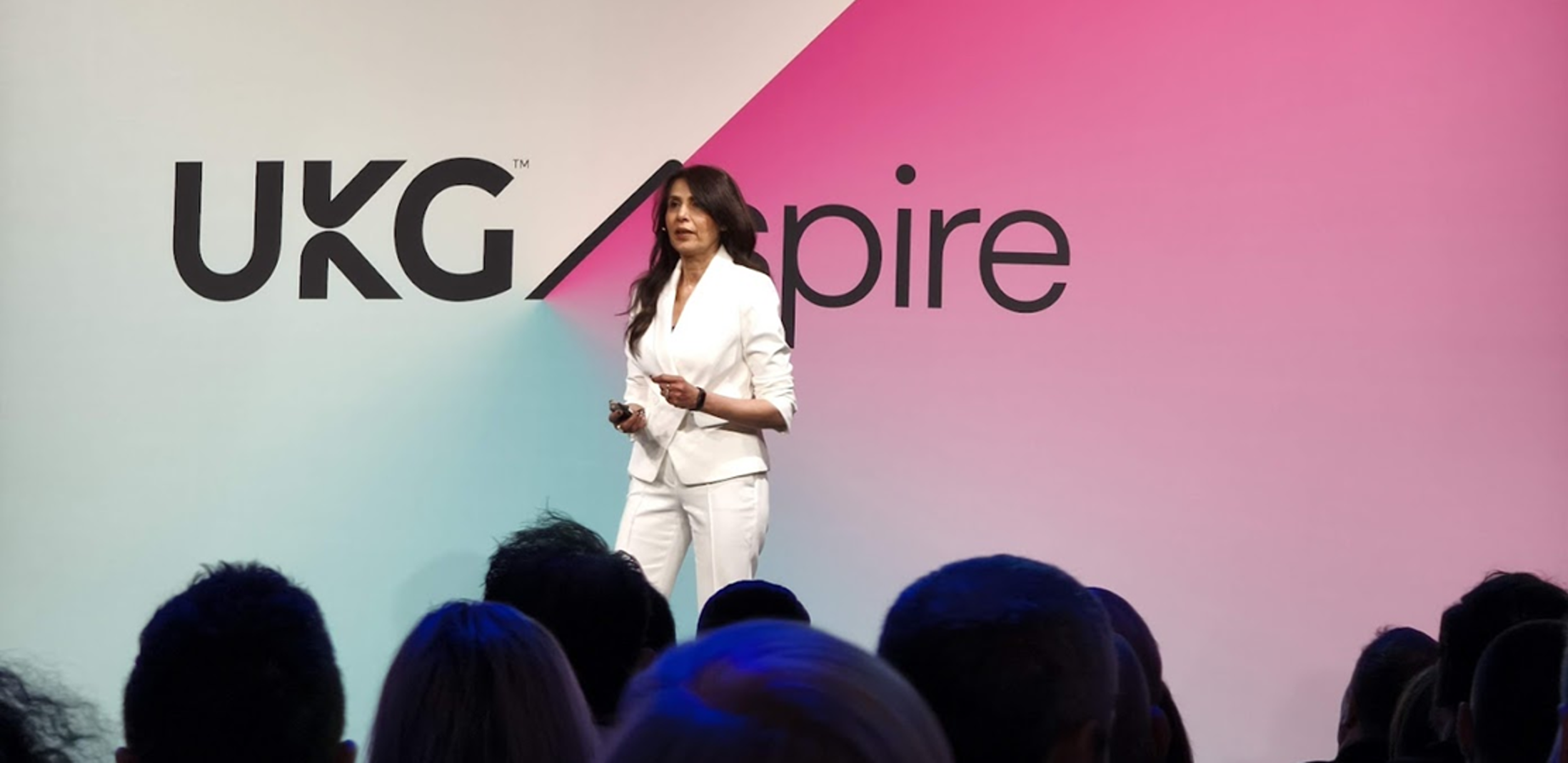
At UKG Aspire EMEA, held at Tottenham Hotspur Stadium, the £1-billion home of a UK Premier League football club and the largest club ground in London, CEO Jennifer Morgan made the case that the next phase of HCM will not be defined by HR systems alone, but by an AI-first workforce operating system that unifies HR, payroll, workforce management, HR service delivery, employee data and AI agents into one operational layer.
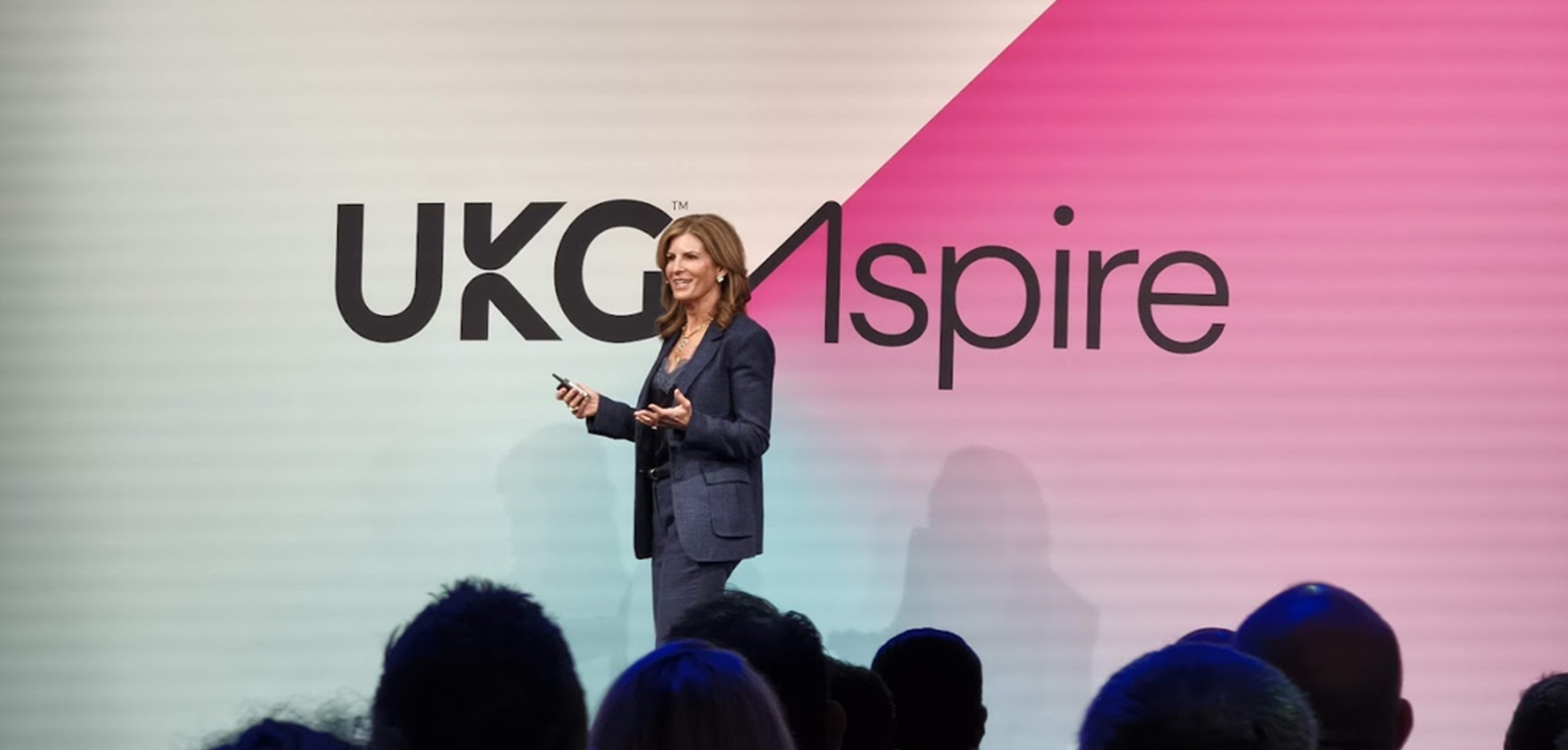
The setting at Hotspur Stadium was fitting. UKG repeatedly used the analogy of high-performance teams, Formula 1 decision-making and real-time execution to reinforce one message: in complex operating environments, winning depends less on instinct alone and more on teams having the right information at the right time, giving leaders and frontline managers the confidence to act.
For HR, payroll and frontline managers, that means moving away from disconnected systems of record toward intelligent systems of action that can identify a staffing risk, pay anomaly, compliance exposure or employee support issue before it becomes a business problem.
Morgan called it an inflection point, especially in Europe, where different labor models, worker expectations, regulatory regimes, and EU AI Act requirements make workforce operations more complex than almost anywhere else. The broader implication is clear: AI in HR will only matter if it can work within this compliance complexity rather than sit above it as another layer of automation.
Workforce AI Moves Closer To The Frontline
UKG reminded attendees that the frontline employees represent as much as 80% of the workforce in many sectors and is where customer experience, patient care, store performance, manufacturing continuity and service quality are determined every day. Unlike the office worker who may touch an HR system a few times a year, frontline employees and managers interact with scheduling, time, pay, communications, absence and workforce systems multiple times a day.
That frequency gives UKG a different kind of AI asset.
Suresh Vittal, UKG’s Chief Product Officer, positioned the Workforce Operating Platform as the foundation underneath the company’s applications, drawing on more than 30 billion frontline interactions, more than $1 trillion in payroll calculations, and more than 10 billion timecard punches. These are not static HR records. They are live signals generated in the flow of work.
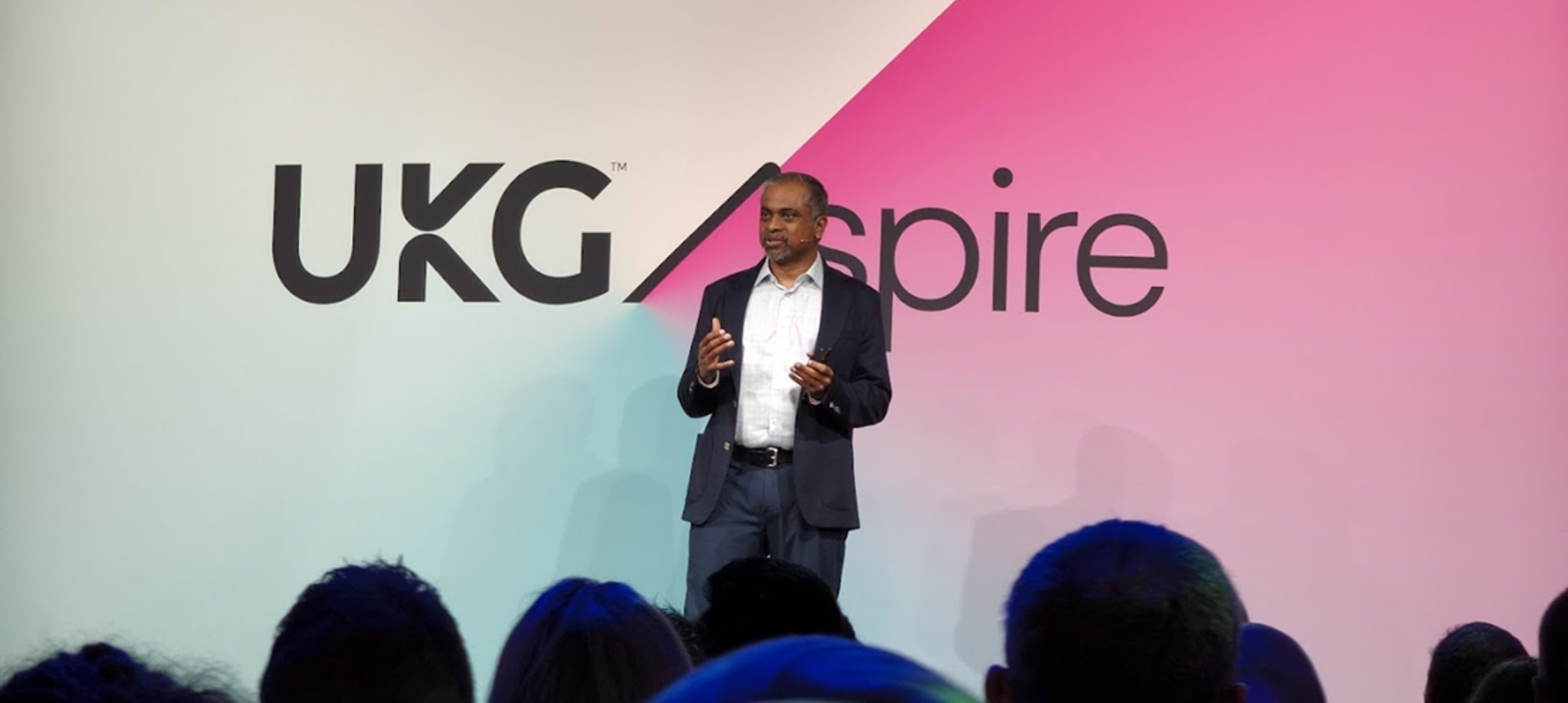
The UKG product direction is to turn those signals into intelligence that can be used by executives, managers, and employees. The UKG Workforce Intelligence Hub is central to that effort, giving leaders the ability to combine UKG data with their own business data to see labor cost, service levels, risk, and operational performance in one place.
That is a meaningful departure from the traditional HCM dashboard. The goal is not simply reporting what happened last month, but surfacing what is changing now, why it matters, and what action should be taken next.
The same thinking extends to UKG Dynamic Workforce Operations, which UKG described as a workforce control tower. Rather than treating scheduling and timekeeping as administrative processes, Dynamic Workforce Operations connects demand signals with workforce data to help managers identify coverage gaps, overtime exposure, compliance risks, and staffing tradeoffs in the moment.
In retail, that could mean aligning store labor to demand before service drops. In healthcare, it could mean spotting staffing pressure before it disrupts patient care. In manufacturing, it could mean protecting output when skill availability starts to tighten.
The message is not that AI replaces managers. In fact, UKG was careful to frame AI as a way to keep people in control while reducing the time it takes to make a better decision. That distinction matters because workforce management is one of the few enterprise software categories where a bad recommendation can affect pay, compliance, employee trust, and customer outcomes almost immediately.
Europe As The Stress Test
The London event sharpened UKG’s global story because EMEA is a natural stress test for workforce AI.
Morgan pointed to European organizations facing regulation as a major headwind, along with fragmented payroll, country-specific labor rules, and operating models that have outgrown legacy systems. In that context, AI cannot be a standalone productivity tool. It needs a clean data foundation, standardized processes, and governance that can handle regional differences.
McAfee was used as one example of why this matters. Following significant business change and the creation of more than 50 legal entities, the company turned to UKG One View to transform its global payroll operating model and improve visibility, accuracy, and consistency across countries. In UKG’s framing, that kind of payroll foundation is what makes AI-speed decision-making possible because AI is only as good as the operational data underneath it.
Sainsbury’s provided another large-scale proof point. With 150,000 employees across 2,400 locations, the UK retailer moved to UKG Pro Workforce Management in one of the more complex workforce environments in Europe, with UKG highlighting zero critical incidents and uninterrupted pay accuracy from day one.
With these examples UKG elevates its AI messaging, underscoring the fact that workforce AI becomes valuable only when it is tied to operational transformation, especially in industries where the cost of being wrong is high.
That message also came through in global payroll. UKG One View is being positioned less as a payroll reporting tool and more as a control layer for multinational employers that need to manage payroll, whether in a couple or in as many as 150+ countries, with third-party payroll providers, native validation, regulatory logic, general ledger integration, and visibility into fully loaded labor costs.
H.B. Fuller, a global adhesives manufacturer operating in more than 40 countries, described how acquisitions had created multiple local providers and disconnected payroll processes. Its takeaway was practical: payroll transformation is not just a systems project; it is an operating model decision. That line may be one of the most important for buyers considering the move to global payroll orchestration.
HR Service Delivery Becomes A Workforce Layer
UKG also spent significant time on HR Service Delivery, an area that is becoming more strategic as organizations try to reduce employee friction without overwhelming HR teams.
Document Manager, People Assist, and Agentic People Assist were presented as parts of a broader shift from case management to guided workforce support. Employees should not need to know which system to search, which policy document to open, or which team to contact. They should be able to ask a question in plain language and receive an answer grounded in company policy, process, and role context.
That may sound simple, but it represents one of the more practical uses of AI in HR. Employees do not want another portal. Managers do not want another queue. HR teams do not want more tickets for repeatable questions. If UKG can make AI-assisted HR support trustworthy, auditable, and embedded in the flow of work, it could reduce manual work while improving employee confidence and experience.
The Unilever France example reinforced this as the company created a unified HR support model for a diverse workforce, including factory and desk-based employees. The cited benefit was not only automation, but freeing HR from low-value administration so teams could spend more time on strategy, training, succession planning, and human contact with employees.
That nuance matters. In HR, automation is rarely accepted when it feels like cost reduction alone. It becomes more compelling when it gives managers and HR teams more time for moments that require judgment, empathy, and context.
From Adoption To Accountability
The London event also showed that UKG is trying to discipline its AI story around measurable outcomes. UKG’s answer is to link AI to labor cost, pay accuracy, service delivery, retention, compliance, and workforce productivity.
Morgan said executives are asking not only where AI can be applied, but how outcomes can be measured and where those outcomes show up in the P&L. That is the right question for the next phase of enterprise AI. In 2023 and 2024, much of the discussion focused on copilots, assistants, and productivity. In 2026, buyers are increasingly asking for business impact.
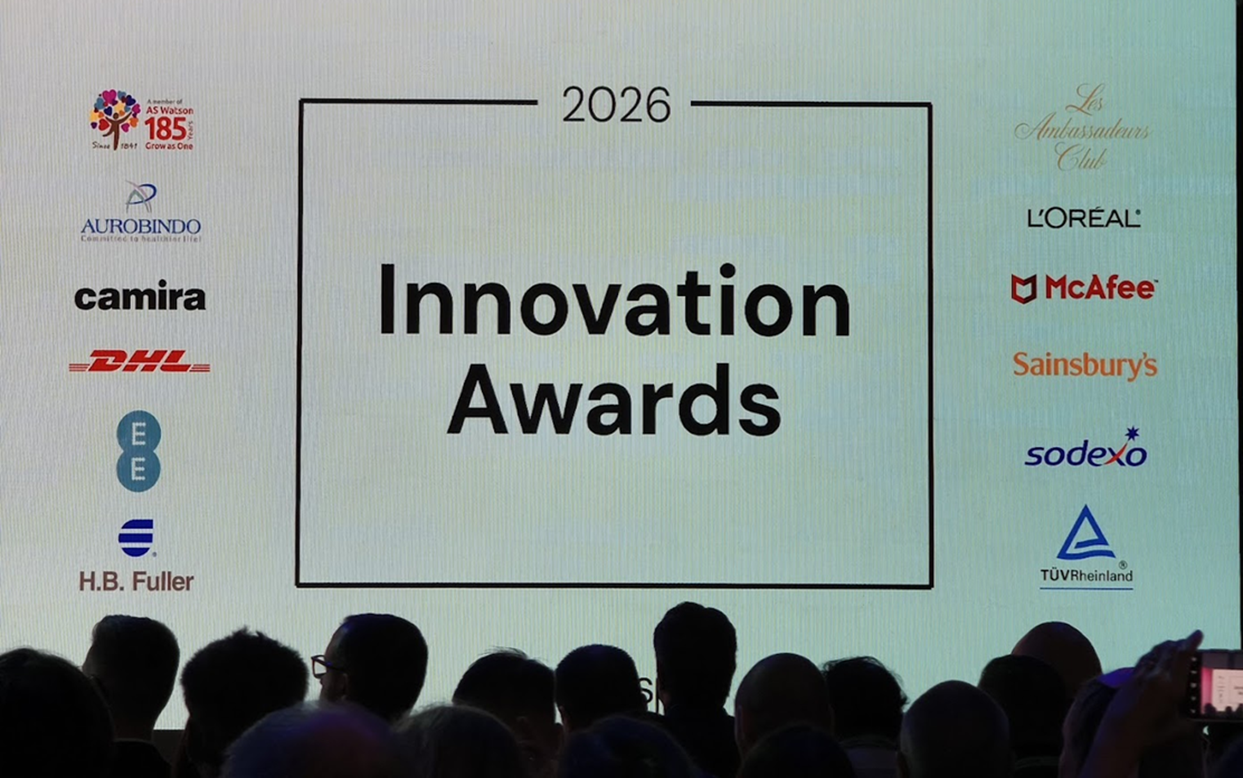
At the event, Seemaa Gilani, UKG’s SVP of Global Delivery Services, presented the 2026 UKG Innovation Awards, recognizing 12 organizations across EMEA that are turning workforce transformation into measurable business outcomes.
The winners, including Sodexo, EE, Camira, McAfee, Sainsbury’s, L’Oréal, H.B. Fuller, DHL, Aurobindo, AS Watson, Le Ambassadeurs Club and TÜV Rheinland, underscored the breadth of UKG’s customer base across retail, manufacturing, hospitality, healthcare, logistics and professional services.
More importantly, the awards reinforced one of the recurring themes of the event: successful workforce innovation is no longer just about system deployment, but about improving adoption, payroll accuracy, employee communication, workforce visibility and operational performance at scale.
McAfee’s 99%+ payroll accuracy, Camira’s 99% global adoption of UKG Ready, Sodexo’s migration from Workforce Central to Pro Workforce Management, EE’s use of workforce data to drive performance insights, and Nespresso’s use of scheduling and forecasting in retail environments all point to the same idea: workforce technology becomes more valuable when it connects labor decisions to operating outcomes.
Camira’s story was especially useful because it showed the midmarket side of the equation. By moving manual time tracking, absence management, and performance processes into UKG Ready, the company achieved near-universal adoption, gave payroll one full day back per month, cut manager administration work in half, and reduced absence-related costs by nearly 30%.
DuPont provided another example of how UKG One View is moving global payroll from a fragmented local process to a more centralized operating model. The company consolidated payroll operations across 14 countries into a single global system, helping streamline processes, reduce vendor contracts, lower system maintenance and payroll staffing costs, and improve payroll accuracy and compliance visibility across regions.
As Melissa Faragher, Global Payroll & Time Leader at DuPont, noted, the company moved away from having full-time payroll resources in each country to a shared-resource model across several countries, a practical example of how payroll transformation can reshape both cost structure and operating discipline.
That is the kind of measurable impact that resonates beyond HR. It gives CFOs, COOs, CIOs, and business unit leaders a reason to care about workforce systems as operational infrastructure.
The Internal Reset Continues
The event also can be viewed against the backdrop of UKG’s ongoing and successful operating reset under Morgan.
As part of its recent reorganization, UKG continues to steadily redeploy resourcing to accelerate its transformation, including applying AI internally for software engineering, DevOps, digital marketing, demand optimization and relationship management.
On one hand, UKG is trying to move faster, increase profitability, and use AI to improve execution. The company appears to be coming off a strong 2026 with high profitability, and the internal use of AI tools such as Claude Code and Google ADK suggests that UKG is not simply selling AI, but also applying it across its own operating model. Completing this initiative under Morgan’s leadership is essential as UKG reinforces its transition from HCM powerhouse to defining a modern category of labor systems, elevating UKG to the same strategic importance – and therefore executive interest – as ERP, ITSM, and CRM.
On the other hand, its latest restructuring may present a new challenge for UKG to prove that AI and partners will improve responsiveness without weakening the human trust that has historically mattered in payroll, workforce management, and enterprise support.
That is why Morgan’s emphasis on speed, confidence, and execution is important. UKG is not only transforming its products. It is transforming how it operates.
People Still Stay In Control
A high note of the event came from the Formula 1 framing.
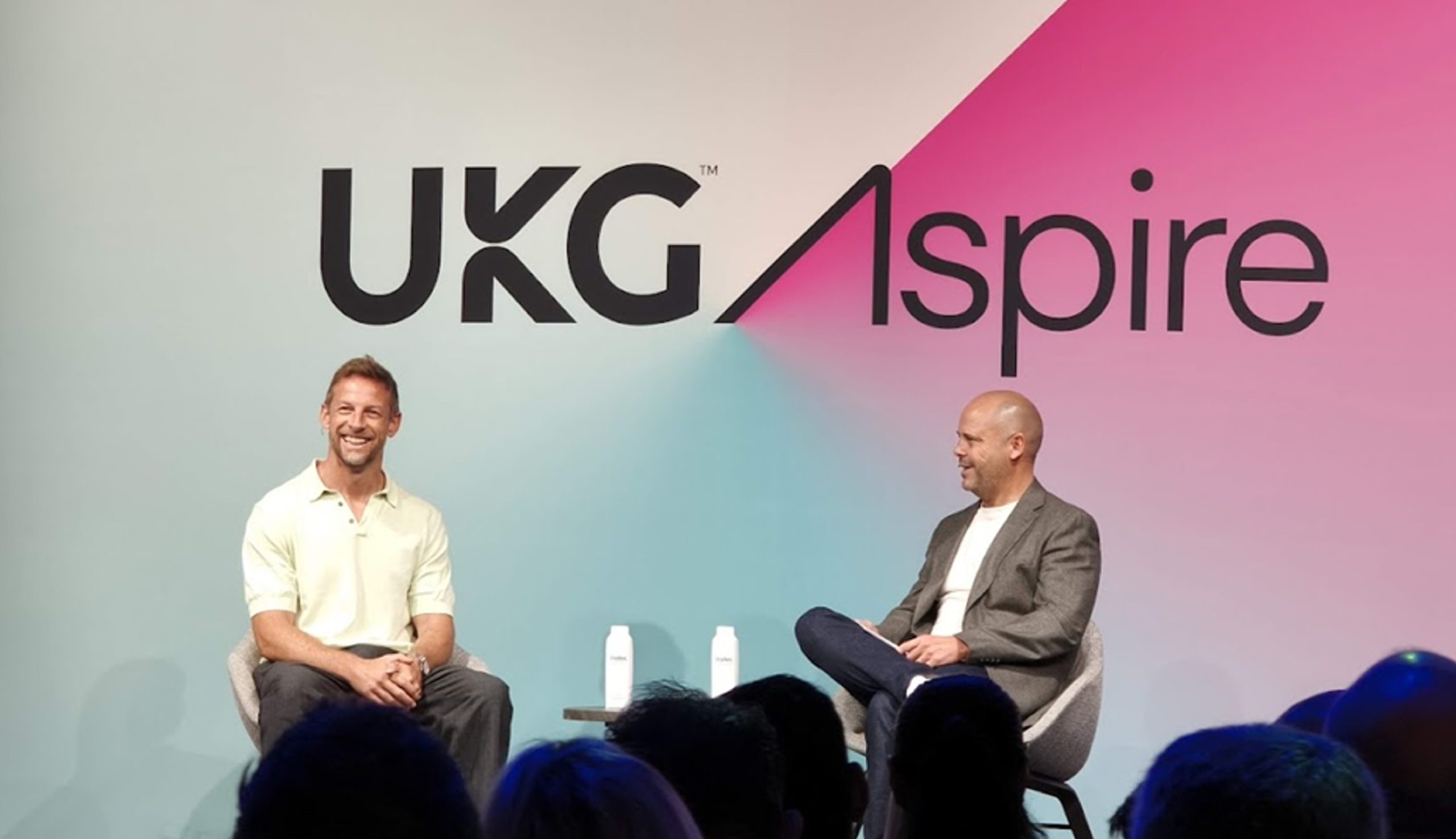
The fireside chat between F1 World Champion Jenson Button and Russell Howe, UKG’s GVP EMEA, was not simply a celebrity keynote. It served as an effective metaphor for UKG’s product direction. In Formula 1, data is critical, but data alone does not win races. Teams need trust, preparation, real-time feedback, and the discipline to remove emotion from decision-making without removing human judgment.
That is also the workforce AI challenge.
UKG’s executives repeatedly said AI should augment, not replace, people. That is easy to say and harder to deliver. The real test will be whether managers trust recommendations enough to use them, whether employees believe AI answers are accurate and fair, and whether HR and payroll leaders can audit the logic behind the automation.
In payroll, trust is everything. One or two errors can undermine employee confidence. In scheduling, a poor recommendation can create overtime, burnout, or compliance exposure. In HR service delivery, an incorrect answer can turn convenience into risk.
UKG understands this. The company’s focus on transparency, policy grounding, governance, and human-in-the-loop decision-making is a necessary counterweight to the agentic AI enthusiasm spreading across the enterprise software market.
The next question is whether UKG can execute consistently across all segments: enterprise, SMBs, global payroll, HR service delivery, and workforce management, while keeping the user experience simple.
The Road Ahead
UKG’s opportunity is considerable.
As the No. 1 vendor in workforce management applications, UKG sits at the center of one of the most operationally important areas of enterprise software. Workforce is often the largest cost line, one of the most dynamic operating variables, and the place where customer and employee experience intersect.
That makes UKG’s AI-first workforce operating system more than a product message. It is an attempt to define the next category: a workforce intelligence layer that can move companies from fragmented HR, payroll, and WFM systems toward a real-time operational system.
The risk is that the ambition could become too broad. Workforce Intelligence Hub, Dynamic Workforce Operations, One View, People Assist, Agentic People Assist, UKG Ready, UKG Pro, UKG InTouch DX, Bryte AI, Great Place to Work, and partner-led delivery all need to work together without creating another layer of complexity. UKG executives know this, but execution will decide whether customers see an elegant operating platform or a growing portfolio that needs more integration.
Still, from what I saw in London, UKG’s direction is becoming focused and clearer.
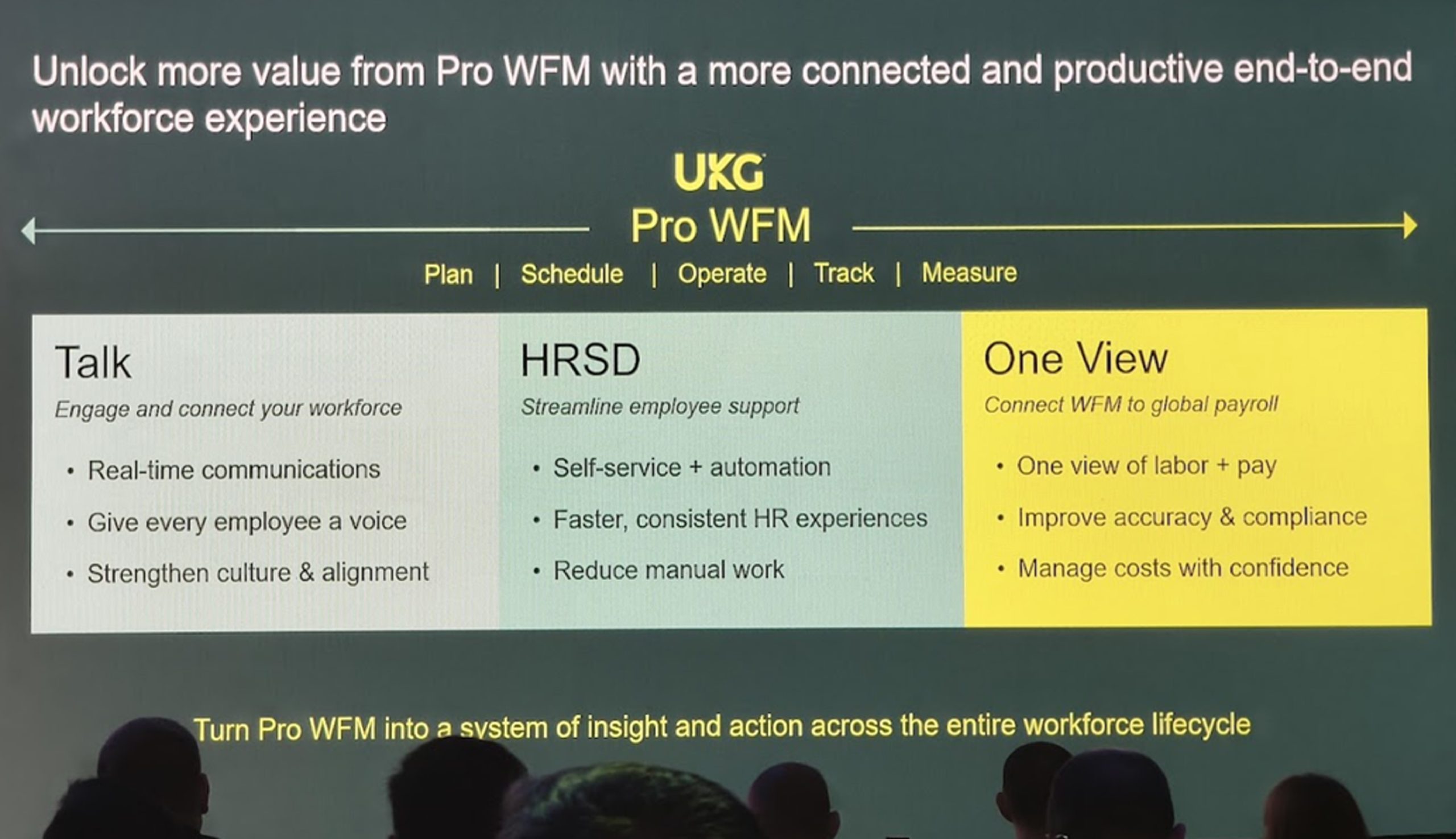
Amy Brar, UKG’s General Manager of WFM Products, reinforced how UKG is extending the value of UKG Pro Workforce Management across the employee journey, moving WFM beyond time capture, scheduling and attendance into a broader execution layer for frontline operations helping organizations act while work is still in motion.
The vendor is not trying to win the AI race by building the flashiest agent. It is trying to win by applying AI to the moments where workforce decisions actually happen: a manager fixing a schedule, a payroll leader validating cross-country anomalies, a frontline worker asking about time off, a CHRO spotting workforce stress, or a CFO trying to understand labor cost leakage before it hits the bottom line.
That is where UKG’s differentiation has always been, close to the work, close to the worker, and close to the data that shows how the business should operate.
If UKG can keep the platform simple, the data trusted, and the AI grounded in real-world workforce operations, UKG could turn its long-standing workforce management franchise into something much bigger: the system of action for the modern workforce.
List of UKG’s Recent Enterprise Customer wins
| Customer Name | Application | Benefits |
|---|---|---|
| McAfee | UKG One View | Delivered 99%+ on-time payroll accuracy across 30+ countries, improving payroll consistency and visibility. |
| H.B. Fuller | UKG One View | Unified payroll across 30+ countries, covering about 80% of the workforce and supporting a more standardized global payroll model. |
| DuPont | UKG One View | Consolidated payroll operations across 14 countries, reduced vendor contracts and payroll staffing costs, and improved compliance visibility during M&A transitions. |
| Sainsbury’s | UKG Pro Workforce | Reached 92% UKG self-service adoption and processed 11,000+ time-off and overtime requests in the first week. |
| Sodexo | UKG Pro Workforce, UKG Talk | Went live across 1,700+ sites with zero payroll disruption, supporting 30,000 employees and improving frontline communication. |
| Camira | UKG Ready | Achieved 30% reduction in pay costs and cut payroll preparation time by 50%, while improving workforce visibility. |
| EE | Workforce Data / Performance Insights | Embedded workforce data into its “My Store” performance hub, enabling near real-time visibility into labor impact and predictive ROI insights. |
| L’Oréal | UKG AI-powered HR Document Management | Standardized HR document management for 95,000 employees, improving consistency and scale across the workforce. |
| TÜV Rheinland | UKG HR Service Delivery | Automated 58,000+ HR requests in one year, reducing manual HR workload and improving service responsiveness. |
| Unilever | UKG HR Service Delivery | Created a unified HR support model for a diverse workforce, improving employee experience and freeing HR teams from low-value administration. |
| Aurobindo Pharma Europe | UKG Workforce Analytics | Moved from manual processes to analytics and automation, improving real-time visibility, faster decision-making, and compliance. |
| Lettuce Entertain You Restaurants | UKG Pro / UKG Talk / Advanced Scheduling | Improved frontline communication, fairer scheduling, compliance support, and transparency around schedules, benefits, and pay. |
| Le Ambassadeurs Club | UKG Workforce Scheduling / Labor Optimization | Enabled smarter, more equitable scheduling and better alignment of labor to client demand. |
