

In today’s race for AI software dominance, there is never a straight line that takes any company from zero to 100 and IFS is no exception. With volatility running rampant among AI providers, IFS is trumpeting something beyond the hype in what its CEO Mark Moffat refers to as no BS AI.
While IFS may not be a household name in AI, its ability to shape things in next-generation computing is hardly in doubt from agents to robots and from data to business processes because of its pedigree, investors and partnerships, in addition to the most important factor of all – its customers covering the who’s who in manufacturing, aerospace and utility like John Deere, Lockheed Martin, and TotalEnergies, according to our Buyer Insight Technographics Database.
At a recent event in New York City, IFS spread its wings further and wider by tapping into the inner sanctum of any organization that makes and maintains products and equipment with a slew of initiatives and partnerships. The central message of its Industrial X is that anyone serious about transforming its operations in the age of AI needs to zero in on three components – product breadth, agility especially in support of strategic platforms as well as turnkey partnerships.
After a series of acquisitions and internal development efforts, IFS has assembled a robust collection of Enterprise Resource Planning for financial management, Enterprise Asset Management for keeping and monitoring assets like cell towers, baggage handling systems and power transformers in tip-top shape, along with service management tools for optimizing field service operations and IT functions.
More recent acquisitions include Loops for agentic workflow, 7bridges for supply chain AI and logistics optimization, and Copperleaf for analytics and integrated planning for risk, sustainability and ESG measures.
With that one is capable of applying the right set of solutions to address the pain points that cannot be easily solved with generic chatbots or AI modeling that spits out poor inferencing because of faulty or incomplete data. Moffat said applying industrial AI in such cases is no different from preparing fixes to a machine before it breaks down by incorporating every bit of information, synthesizing it and scheduling the steps needed to swap out parts after pinpointing their mean time between failures.
One can do wonders by applying the same philosophy to boost customer satisfaction by eliminating shipping mistakes, lower attrition among overworked employees through smart scheduling, or even thwarting recidivism among alcoholics and convicts by picking up early signals and extending help in advance.
Ecosystem support is another key plank of its Industrial AI strategy. This year, IFS trotted out a host of new and expanded alliances with the likes of Anthropic for B2B large-language-modeling, Boston Dynamics and 1X Technologies for robotic integration, and Siemens for grid planning and asset management.
‘‘We are putting human, digital and robotic into one system,” Moffat said, adding that IFS has already delivered more than 2,000 assessments and templates on its so-called Industrial X Applied, generating tangible value in bottom-line savings and top-line benefits to many of its 5,000 customers.
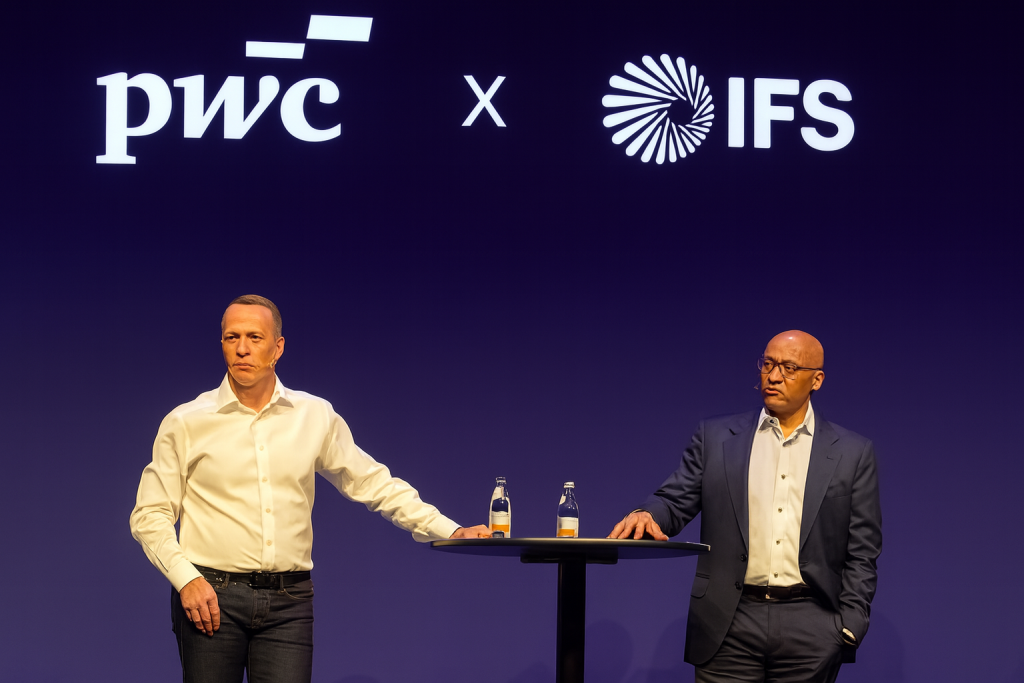
In addition to its partnership with Microsoft for Azure development, IFS spared no effort to promote its alliances with PWC, Accenture and Deloitte, which have impressed upon hundreds of attendees at the event with the importance of the Industrial AI pivot. Mohamed Kande, global chairman of PWC, added that what’s at stake is not just the necessity to improve their efficiency but also rendering them with a more defensible position amid stiffening competition at the global level.
IFS also launched its AI accelerator engine called Nexus Black that aims to speed time to market for AI development efforts by offering templates for use cases like predictive maintenance, manufacturing scheduling and intelligent automation. All these developments underscore the new journey that IFS has embarked on since it went private in 2016 after decades of building out its ERP applications offerings for manufacturers in Europe, Americas and Asia Pacific under its old name Industrial and Financial Systems.
In March, its owner PE firms EQT and TA Associates rebalanced their portfolios by selling a big chunk of IFS to Hg and other investment funds. HgTrust, now a co-controlling shareholder, would invest approximately an additional £124 million in IFS to fund its expansion.
In its first half of fiscal 2025, IFS announced a 30% rise in annual recurring revenue and a 37% jump in cloud revenue. Total revenue exceeded 1.2 billion euros in 2024. In a filing with the UK authorities, IFS said its UK division saw a 30% increase in total revenues to $204 million in 2024 with UK customers contributing to a 40% spike in sales.
Whether IFS can repeat that depends on how customers can replicate some of IFS’ use cases at a global scale and overcome inertia. One major US equipment manufacturer who attended the event said it’s one thing to use AI automation to save a few minutes or even a few hours for any workflow, but it’s something else altogether to expand it across the board in order to achieve the overall organizational efficiency. Equally essential is to find ways to resist any pushback from employees through effective change management, he added.
Samples of IFS 2025 Customer Wins
Source: APPS RUN THE WORLD Technographics Platform, December 2025
- Tilli Software, a United States based Professional Services organization with 90 Employees
- Oracle, a United States based Professional Services company with 162000 Employees
- Global Cti Group, a United States based Communications organization with 40 Employees
| Logo | Company | Industry | Employees | Revenue | Country | Evaluated |
|---|
