

The next phase of AI adoption lies in how companies are making the best use of enterprise data, analytics and the cloud infrastructure support needed to run all three effectively and efficiently with Oracle capitalizing on its strengths in all these interdependent markets.
The trifold differentiator is particularly important for Oracle to stand out amid a shifting competitive landscape in the Analytics and Business Intelligence software market now split into incumbents and fast-growing challengers, all vying to make insights, data visualizations and recommendations immediately accessible to business, technical and general users, in many cases autonomously with the help of AI.
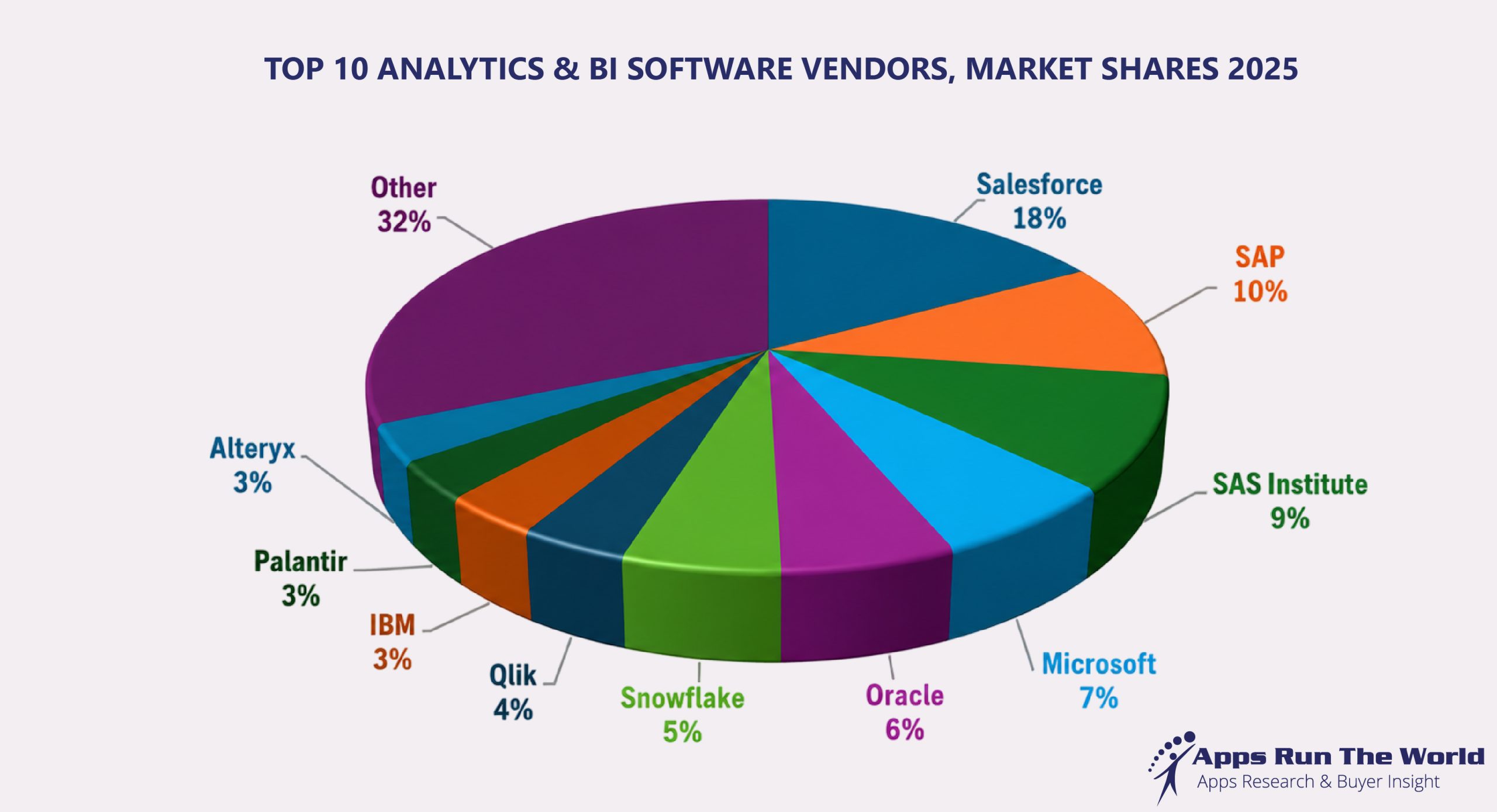
On one hand, incumbents including Microsoft, Oracle, SAP and SAS Institute have garnered tens of thousands of Analytics and BI customers through the decades. As shown in the following Exhibit 1, with the exception of SAS, all of the above incumbents saw a double-digit increase in their Analytics and BI software revenues in 2025, according to our survey of thousands of these vendors for hundreds of updated market-sizing reports due out later this month.
Exhibit 1 – Top 10 Analytics and BI Software Vendors, Their 2025 Revenues and Growth from 2024
| Rank | Vendor | 2025 Analytics and BI Apps Revenues, $M | YoY Growth |
|---|---|---|---|
| 1 | Salesforce | $3,988 | 32.4% |
| 2 | SAP | $2,148 | 11.1% |
| 3 | SAS Institute | $1,967 | 2.8% |
| 4 | Microsoft | $1,458 | 11.3% |
| 5 | Oracle | $1,247 | 9.5% |
| 6 | Snowflake | $1,151 | 24.6% |
| 7 | Qlik | $814 | 12.1% |
| 8 | IBM | $742 | 3.9% |
| 9 | Palantir | $686 | 47.2% |
| 10 | Alteryx | $596 | 2.9% |
| Subtotal | $14,797 | 15.5% | |
| Other | $6,902 | -8.7% | |
| Total | $21,699 | 7.0% |
Both Snowflake and Palantir grew their Analytics and BI software revenues by at least 25% in 2025 and our assumption is that they will experience similar increases in 2026 spurred by their enterprise and government businesses. Databricks reported exceeding $5.4 billion in its annual run rate in 2026, a 65% jump from 2025. Assuming 10% of its revenues is allocated to Analytics and BI, that came to anywhere between $250 million and $325 million in 2025.
The 10% allocation is modeled after that of suite-based incumbents like Oracle, Salesforce and SAP that now derive about 10% of its software revenues from Analytics and BI.
On the other hand, the Frontier AI labs including Anthropic and OpenAI announced staggering growth over the past 12 months. Again, extending the 10% allocation to Anthropic and OpenAI’s annual run rate and recognizable revenues in 2026, the Analytics and BI-equivalent revenues for Anthropic and OpenAI could amount to $1.5 billion for the former and $1.25 billion for the latter.
Even after giving a haircut for their sell-through revenues from a host of OEM, channel and MSP partners, the Analytics and BI-equivalent revenues for Anthropic and OpenAI could top $750 million and $625 million, respectively, in 2026.
What that suggests is that almost all of the leading Analytics and BI software vendors are jockeying for the No. 2 or 3 spot in 2026 with Salesforce taking the lead because of its acquisition history that results in a bigger base of products to work with, including Tableau, Informatica and Salesforce Data Cloud.
Regardless of when and how that happens, the rise of Anthropic, Databricks and OpenAI is threatening the market presence of IBM, Alteryx, Cloud Software Group, while posing serious challenges to those top five or six vendors that are likely to grow at low double-digit at best in 2026.
It is against that backdrop that the announcements at Oracle’s recent Analytics Summit have struck a chord among its customers and partners.
At the event, Oracle executives, customers and service providers ushered in a collective partnership that could shape how AI and the onslaught of agents are being deployed and consumed by a full spectrum of key stakeholders from IT to Line of Business users, both of whom are also required to collaborate closely in order to mitigate risks and optimize business outcomes.
The event highlighted Oracle’s key differentiators – namely AI is only as valuable as the enterprise data behind it, a framework that is strengthened by tight integration of FDI, AIDP, and OCI Enterprise AI as discussed below, as well as customer outcomes that demonstrate the value of that approach.
At the heart of this new Partnership of AI is a trio of three revamped Oracle offerings – Fusion Data Intelligence (FDI), AI Data Platform and OCI Enterprise AI that aim to make workflow automation simple, straightforward and predictable.
FDI now serves as the engine behind dozens of new Oracle’s agentic applications delivering contextual insights and recommendations across functional areas from ledger automation for revenue modeling to time-based planning assistants for better decision support and from conversational dashboard for everyday cost control and spend management to workforce planning simulation.
Customers are already taking advantage of a combination of embedded analytics and AI agents. After running FDI to help lower attrition by nearly five percentage points over a two-year period among its employees, Howmet Aerospace now expects greater cost savings and efficiency gains by leveraging AI and ML agents for upskilling automation to reduce turnover further.
Introduced in October 2025, AI Data Platform is Oracle’s answer to a myriad of data management and lakehouses from the likes of Databricks, Palantir and Snowflake. By refining its data warehouse products, Oracle AIDP is positioned as a more cost-effective solution without retooling and acquiring third-party products for existing customers, especially those on-premise ERP and industry-specific users that want to continue running their current instances while exploiting AI advances through leading edge object stores, roll-your-own agents, and data catalogs derived from a new master data management framework for better performance, reducing duplicates and record standardization.
Apps Associates, a long-time Oracle partner, has deployed AIDP on behalf of a growing number of customers successfully transforming their operations with predictive insights – all derived from transactional and applications data from Oracle and other data sources – to pinpoint the shared attributes of individuals or projects despite their different origins from email addresses to templates, while offering accurate and predictable scenarios that drive better customer experience.
Clinical Research Centre at University College Dublin went one step further using AIDP to launch a pilot under four weeks that helped patients better manage their chronic respiratory conditions by harnessing a myriad of datasets from weather to pollen counts and from health symptoms to treatment protocols.
Tony Cassidy, chief executive of Vertice that partners with UCD, said the research centre will expand its AIDP deployment to focus on predictive alerts when trials deviate from KPI targets or budget trends.
OCI Enterprise AI forms the third leg of Oracle’s AI journey that encompasses agent management, AI modeling and governance. OCI Enterprise AI, a part of Oracle Cloud Infrastructure, shares the same pane of glass as other key OCI components, thusly resulting in better insight. The product competes with those from hyperscalers like Microsoft Azure Fabric.
Newfold Digital, an Oracle customer that hosts websites for millions of small and midsized companies, said the use of OCI has reduced its overhead, along with availability of tools like vector search that comes with OCI Enterprise AI for improved knowledge lookup, delivering more competitive price performance than Azure.
Federico Torreti, vice president of AI product at OCI, said more than 2,400 customers in industries like communication, construction and utility are running advanced AI solutions enabled by OCI Enterprise AI.
In the construction and engineering vertical, for example, the combination of OCI Enterprise AI and Oracle’s industry applications like Primavera for project portfolio management has made possible automatic generation of insights when scheduling building materials delivery, analyzing labor costs or updating project status by P/L.
The upshot, according to Todd Randolph, principal of corporate services at KPMG, is that the trifold differentiator is the key for Oracle to accelerate its growth momentum, perhaps at the expense of a whole crop of new players such as Databricks, Palantir, Snowflake, not to mention frontier AI labs like Anthropic and OpenAI, all of which are eager to extend their AI building blocks to next-generation analytics for everyday use.
Instead of paying Databricks millions of dollars to build a lake house, Randolph said products like AIDP and OCI Enterprise AI could be considered a low-cost alternative when factoring into predictable infrastructure costs and FDI applications bundling.
If that resonates with customers and partners, Oracle’s push into the next frontiers for Analytics and BI dominance could be a wake-up call for new and existing players.
List of Oracle AIDP and FDI Customers
Source: APPS RUN THE WORLD Technographics Platform, June 2026
