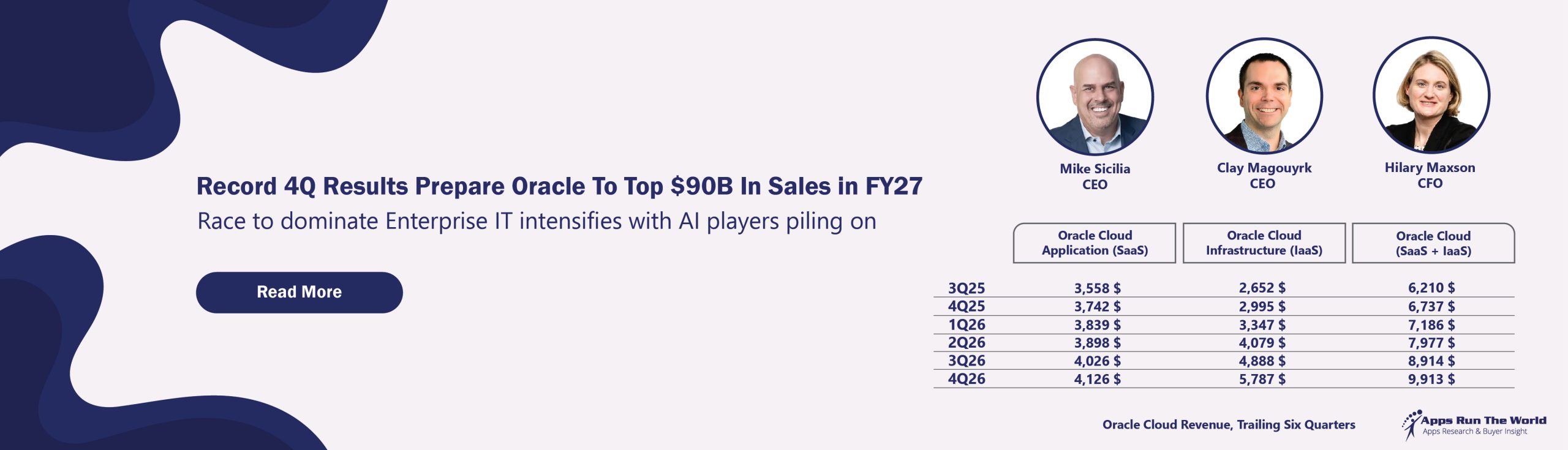
Oracle reported record revenues for its latest quarter with a trajectory to becoming a $90-billion-plus company on the strengths of the fast-growing Oracle Cloud Infrastructure (OCI) and double-digit increases in its Cloud applications business.
If it sustains its current momentum over the next 12 months, Oracle is expected to secure the No. 3 spot in worldwide sales of Enterprise IT products, based on the trailing four-quarter revenues of its closest competitors, as shown in the exhibits below.
Exhibit 1 – Enterprise IT Incumbents and Challengers, 2026 Year-to-date Performance and 2027 Forecast, $B
Trailing Four-Quarter Revenues, $B
Forward-Looking 12-Month Revenues, $B
Projected Growth Rate, %
Enterprise IT Products
Microsoft
$169
$211
25%
Microsoft Intelligent Cloud, Enterprise Productivity and Business Processes Derived Revenues
AWS
$123
$157
28%
Amazon Web Services Reported Revenues With Adjustments
Oracle
$67
$90
34%
Oracle Reported Revenues
Google
$66
$86
30%
Google Cloud Reported Revenues
SAP
$44
$49
12%
SAP Reported Revenues
Salesforce
$42
$46
11%
Salesforce Reported Revenues
Anthropic
$10
$30
200%
Anthropic Business AI Revenues
OpenAI
$7
$13
79%
OpenAI Business AI Revenues
Subtotal
$528
$682
29%
Other
$807
$730
-10%
Total
$1,334
$1,412
6%
Semiconductor
$874
$953
9%
Grand total
$2,208
$2,365
7%
Source: ARTW Buyer Insight Vendor Database, June 2026
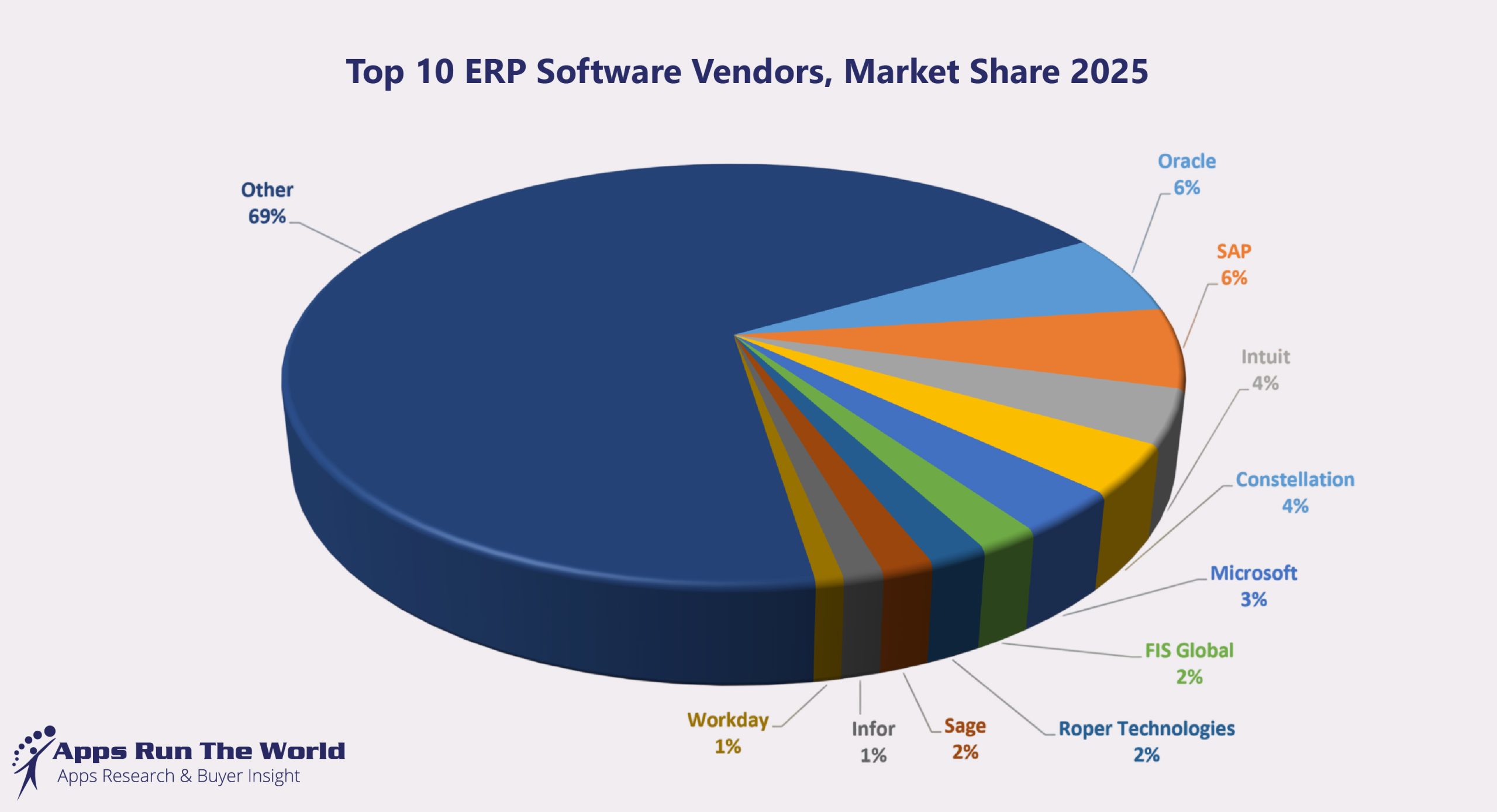
Similarly, the following exhibits show Oracle’s core financial management and industry-specific ERP applications such as those for patient accounting in healthcare continue to lead the market, retaining the No. 1 position in the mission-critical software market in 2025.
Exhibit 2: Top 10 Worldwide Enterprise Resource Planning Applications Market, 2024-2025 Size in $M, Growth, %, and 2025 Market Share, %
Rank
Vendor
2024 ERP Apps Revenues, $M
2025 ERP Apps Revenues, $M
YoY Growth, %
2025 ERP Market Share, %
1
Oracle
$8,769
$9,719
11%
6%
2
SAP
$8,688
$9,610
11%
6%
3
Intuit
$5,686
$6,497
14%
4%
4
Constellation Software
$5,146
$5,841
14%
4%
5
Microsoft
$4,505
$5,119
14%
3%
6
FIS Global
$2,794
$2,917
4%
2%
7
Roper Technologies
$2,490
$2,861
15%
2%
8
Sage
$2,229
$2,459
10%
2%
9
Infor
$1,864
$1,900
2%
1%
10
Workday
$1,234
$1,422
15%
1%
Subtotal
$43,405
$48,345
11%
32%
Other
$92,531
$103,223
12%
68%
Total
$135,936
$151,568
11%
Source: ARTW Buyer Insight Vendor Database, June 2026
In both cases, Oracle is poised to expand further given its unique blend of its proven applications and database offerings that are difficult to replace and its cost-effective hyperscaler operations, which benefits from a growing base of frontier AI labs that are increasingly driven by public investors for improved financial results.
As a result, OpenAI, intending to go public later this year, is committed to buying billions of dollars in OCI capacity in 2026 and beyond. Even as Anthropic, OpenAI and other frontier AI labs are expanding beyond foundation models into business-focused offerings that could increasingly overlap with the domains traditionally served by Microsoft, Oracle and SAP, they still need to run OCI to help facilitate their growth.
Still, the meteoric rise of Anthropic and OpenAI is threatening the market presence of a swath of Cloud applications providers by more than doubling the revenues of their Business AI offerings in a compressed timeframe, while posing long-term challenges to the top four Enterprise IT players that are likely to grow at double-digit rates at best in 2026-2027 timeframe.
It is against that backdrop that the latest earnings results from Oracle provide an early indication of which companies are likely to emerge as winners or losers in the $3-trillion Enterprise IT market. The sector’s growth is increasingly attracting highflyers like SpaceX, whose recent public-market debut valued the company at roughly $2-trillion on lofty ambitions for its emerging hyperscaler business – including the promise of orbital data centers – along with its satellite bandwidth and rocket operations.
Top 10 ERP Software Vendors, Market Share 2025
For the quarter, Oracle’s 47% jump in its Cloud infrastructure and applications translated into an almost $10 billion business, overshadowing its one-time software license and legacy maintenance sales, which dropped 2% to $6.8 billion for the quarter.
Oracle’s backoffice applications including its Fusion ERP Cloud climbed 12% to reach $1.5 billion for the quarter, while NetSuite rose 9% to secure $1.1 billion. Industry-specific applications including ERP systems for verticals like healthcare and construction went up 8% to hit $1.2 billion. All these are riding on the back of customers adopting these mission-critical products alongside their full embrace of AI. Mike Sicilia, CEO of Oracle, said its deferred revenues of its cloud applications soared 16% for the quarter with 300 Fusion customers going live during the three-month period.
For the full year, Oracle’s Cloud revenues totaled $34 billion, up 39%, while software license and maintenance sales fell 1% to $24.5 billion. Hardware revenues rose 5% to $3 billion and services were up 10% to hit $5.7 billion. Companywide revenues topped $67.3 billion, representing a 17% increase.
All these developments presage a seismic shift in the enterprise IT market as Generative AI starts generating substantial growth for Oracle and its peers. Sicilia added that Oracle has delivered more than 1,000 AI agents across its applications suite, while introducing new outcome-based pricing to drive rapid adoptions prompted by customers need for quick and quantifiable returns before they invest further in AI.
Clay Magouyrk, Oracle CEO, said the vendor has signed $67 billion in AI infrastructure contracts during the quarter, helping propel its remaining performance obligations to $638 billion in committed orders.
The flip side of this shift that makes it possible for companies to leverage AI will first come at the expense of those willing to assume the data center buildout requirements before AI training and reasoning become pervasive. In the case of Oracle, that means a net cash outlay of about $70 billion in capital expenditures in fiscal 2027, according to its new CFO Hilary Maxson.
In the enterprise applications market, Sicilia said Oracle is well positioned to take advantage of organizations moving swiftly to AI implementations that complement mission-critical applications equipped with domain expertise and a robust database for tight interoperability and trusted results.
For example, the vendor has been awarded a $396 million contract by the U.S. Office of Personnel Management to implement Oracle Fusion Cloud HCM applications that make extensive use of agent-enabled workflows in a secure platform for US government’s two million civilian employees.
Such demands, coupled with the latest quarterly results from Oracle, suggest that the cloud applications era is far from over. The inevitable moves by frontier AI labs to expand into enterprise applications are simply adding another dimension to an evolving marketplace that has everything to gain but very little margin for error for all the key stakeholders involved. Or for that matter, anybody else wanting to take a crack at this must confront the fact that they are now in a high-stakes battle that has never been more rewarding and risky at the same time.
Customer highlights from Oracle’s Q4 FY26 earnings