

 The historical run of Oracle catapulted the vendor to new heights in valuation and projected revenues, and its recent AI World provided the perfect exhibition to showcase its heritage, while seizing every moment to further its momentum in generating even more excitement surrounding Generative AI.
Larry Ellison, the 81-year-old Oracle chairman and CTO, has on multiple occasions, including at AI World in October, characterized the AI ambitions among many of Oracle’s biggest customers and partners as astonishing.
This report helps illustrate different scenarios that could play out even if the much talked about AI bubble is about to burst. In the end, Oracle could still prevail by taking advantage of any or all of these options – making agents a permanent fixture of its sticky and mission-critical applications, creation of a private AI instance for each and every one of its software customers, and capitalizing on market adjacencies from Oracle AI Agent Marketplace to Oracle Cloud Infrastructure (OCI).
Today, heavyweights Oracle, Apple, IBM, and Microsoft belong to an exclusive club that has been battlefield-tested through the decades leaving little doubt on their capacity to endure and withstand any future shock. The real question is how and what they will become once the dust is settled.
Path to Oracle AI World
Despite the name change and a few surprises, the inaugural event continued its tradition of serving the needs of its core database, applications and industry customers.
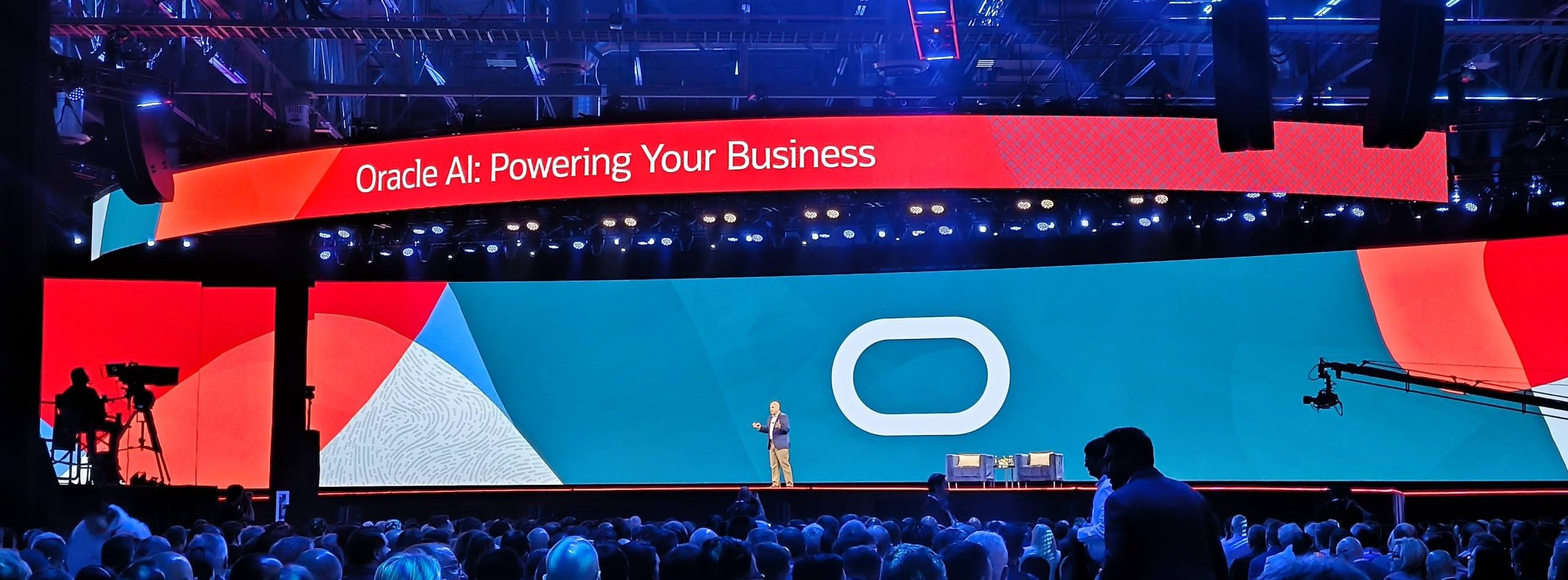
For starters, the three-day conference attended by thousands of customers and partners in Las Vegas started out with two marquee keynotes led by Oracle’s new CEOs – Mike Sicilia and Clay Magouyrk. The former is in charge of its important applications and industry solutions, while the latter runs its popular and viral cloud infrastructure operations that host AI modeling and inferencing for a swath of clients from Meta to OpenAI.
They succeed Safra Catz, now holding the post of executive vice chair of the Oracle board of directors after 11 years of presiding over Oracle’s successful transition from an on-premises vendor to the cloud. As part of her legacy, Catz was also instrumental in strengthening Oracle’s culture and social impact on many communities it serves.
The name change from CloudWorld follows the banner that Oracle has been carrying for the past two years that AI represents a watershed moment in computing with huge amounts of capital needed to bring to life the lofty goals that many visionaries have been dreaming about—a cure for cancer, an end to hunger, or simply the catalyst that could radically improve business productivity and quality of life beyond imagination for all parties involved.
Against that backdrop may well be the tantalizing proposal to massively implement private AI programs, which could reshape the software industry with Oracle perhaps becoming one of the biggest beneficiaries in the long run.
Even without turning any of the above grandiose statements into a reality in our lifetime, the fact that AI could help Oracle sustain its core operations for years to come would be more than enough to justify the heavy investments.
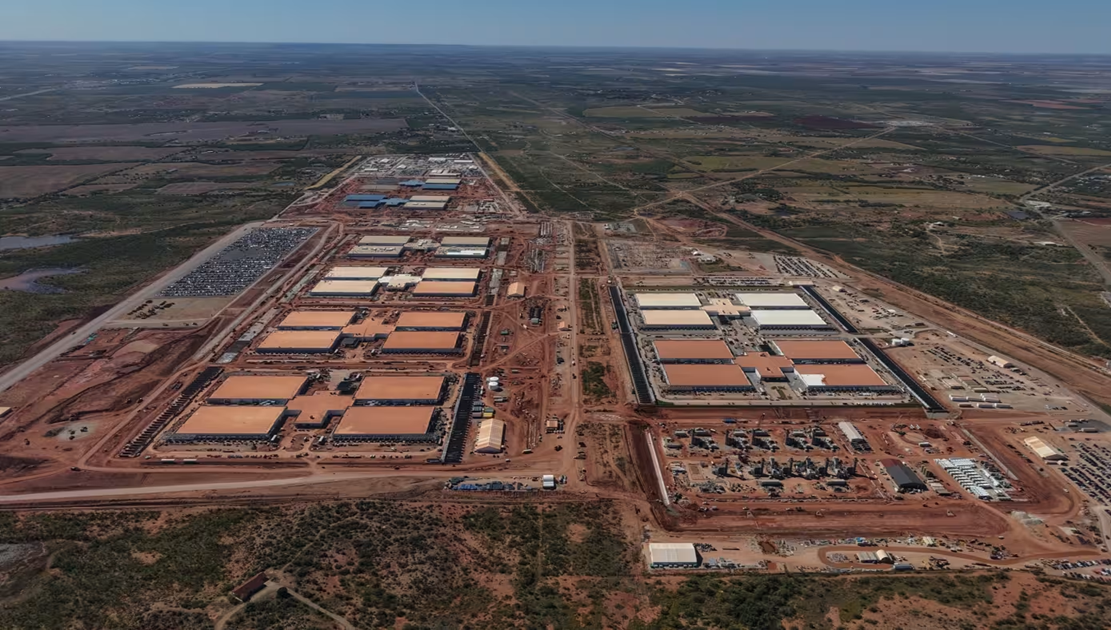
Already, Oracle’s capex (with the bulk slated for building out OCI including a cluster of data centers in Abilene, Texas, spanning 1,100 acres) topped $8.5 billion in the first quarter of its fiscal 2026, up from $21.5 billion it spent for the full year of FY25. If the pace continues, Oracle could commit hundreds of billions of dollars over the next few years just to keep the biggest customers of OCI like Meta, OpenAI, and xAI fully engaged in revolutionary AI modeling and inferencing.
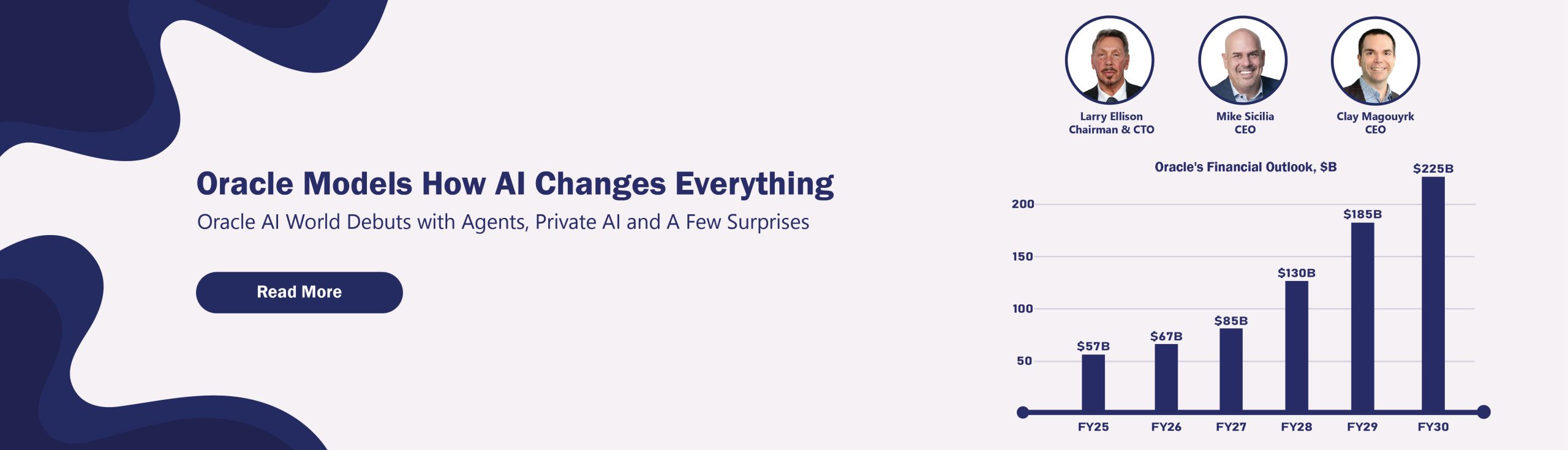
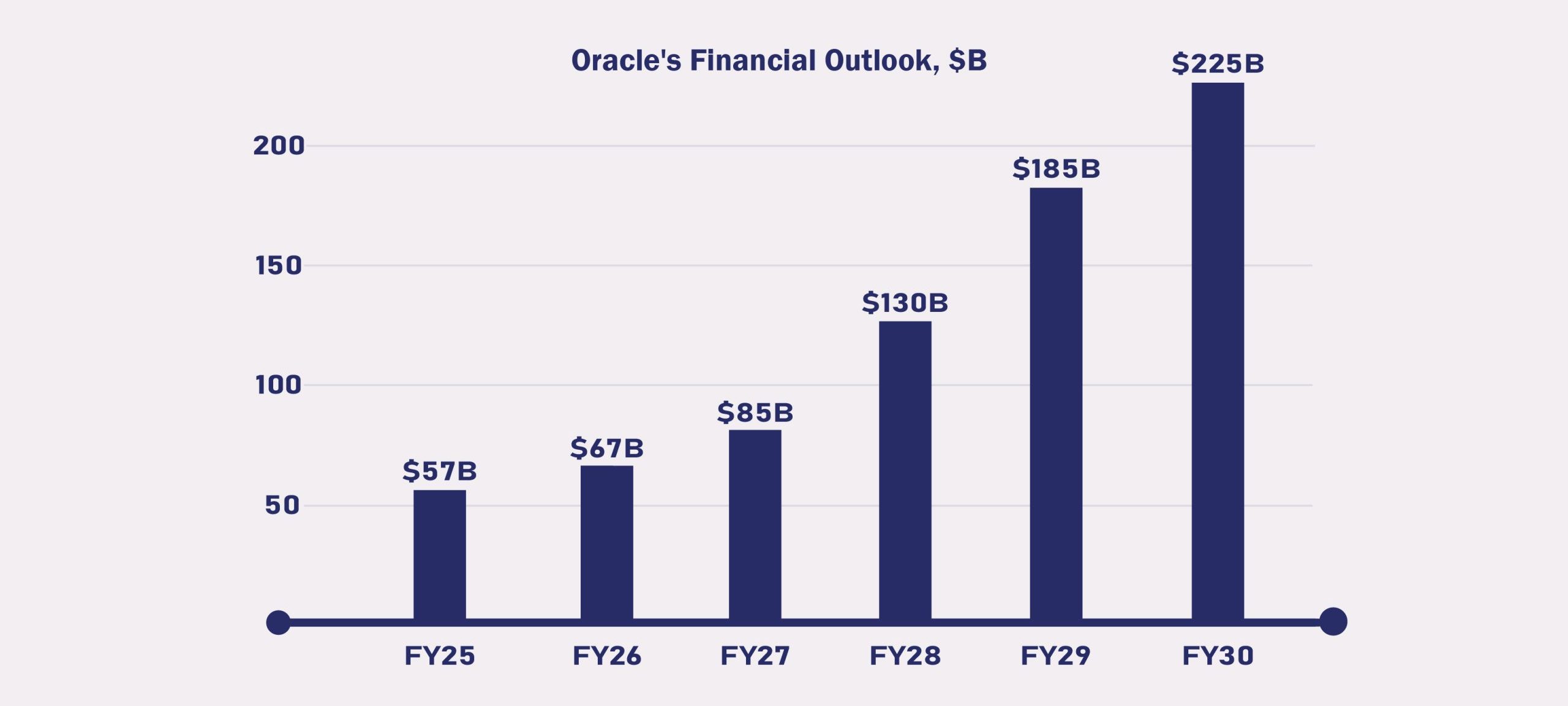
Unlike the Dot Com boom, the stakes are higher than ever, potentially resulting in trillions of dollars in stock valuation increases. Fueled by the explosive growth of OCI in serving AI companies big and small, Oracle now projects its revenues to top $225 billion by the end of its fiscal year 2030, a 236% jump from $67 billion in its current fiscal year ending May 2026. Before Oracle or any AI platform reaches the zenith, a number of scenarios could emerge even if the current AI hype takes a tumble.
Explosion of Agents
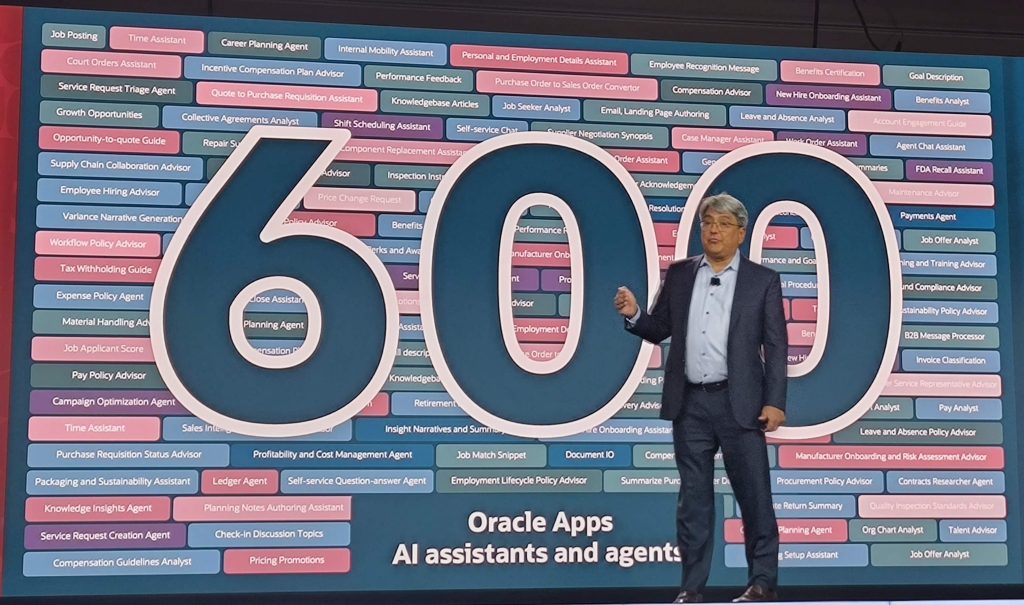
Agents could be the next metaphor for enterprise applications quickly boosting their utilization as they make both preemptive and reactive moves on behalf of humans. In Las Vegas, Oracle executives announced more than 600 agents and 100 more were added in one single hackathon during the three-day event. The assumption is that tens of thousands could surface in a short amount of time. Question is how useful they will be.
Mike Sicilia, the new CEO of Oracle, is emphatic about the value of agents, adding that more than 2,400 customers are currently using Oracle AI applications including 162 agents that have already been developed for its core banking and ERP systems for such functions as payments, payables, and G/L.
Sam Yen, Global Head of Enterprise Application Solutions, Commercial and Investment Banking Payments at JP Morgan Chase, demonstrated during one of the keynotes an agent-to-agent interaction being used by the bank to facilitate supplier recruitment and payment processes that help suppliers boost cashflow by accepting virtual cards for payments from buyers that sweeten the pot with better terms. In other words, AI agents emerge as the key enabler that benefits everyone through touchless and efficient operations.
Steve Miranda, executive vice president of Oracle Applications Development, said the proliferation of agents will have considerable impact on the flow of work being done across enterprise applications, reiterating the mantra that AI is the key to application development at Oracle and elsewhere. “AI is intrinsically tied to the future of Oracle,’’ he said, adding that agents in applications are akin to peas in the same pod. “Our UI will certainly change, but applications won’t be replaced (by AI),’’ Miranda said.
Chris Leone, executive vice president, Oracle Applications Development and the person responsible for leading AI Agent teams, said during a packed keynote that with these useful agents working nonstop to automate everything from sales orchestration to HR and recruiting, enterprise AI at scale is operational. Echoing other Oracle executives at the event, Leone implores the crowd to migrate from their on-premises systems to the cloud so that they can take immediate advantage of all the AI agents and capabilities, which come at no additional cost, that are embedded in Oracle Fusion Cloud Applications.
Database for Private AI Push
Another recurring theme from the conference—attended by thousands of customers and partners in Las Vegas—was the path toward private AI developments.
Relying on its core strengths in databases and applications, the move to private AI developments might turn out to be more lucrative for Oracle even if the current hype is centered on the stupendous growth of OpenAI.
During its Investor Day, Ellison, chairman and chief technology officer of Oracle, reiterated the intrinsic value of private AI developments that Oracle is helping its customers accomplish. Such initiatives will allow these customers to turn their treasure troves of data—all residing on Oracle databases for nearly 50 years and not likely to be touched by ChatGPT anytime soon—into strategic opportunities by harnessing AI inferencing and reasoning.
“How do you take your private data, make that available to AI models, while keeping that private data private? And can we make that easy to do? Because everybody, everybody wants to do that. And we’ve been working on this problem for some time,’’ Ellison said.
Even with the advances in LLM modeling and the rush to building out data centers, Karan Batta, senior vice president of OCI, said there might not be enough capacity for years to handle the AI inferencing and reasoning that customers want to harness out of their Oracle AI Database workloads using the latest vector search capabilities that cover all artifacts from text to videos and images in Oracle AI Database 26ai.
Big bets are being made by Oracle and its partners with systems integrators like Accenture, Cognizant, Infosys, KPMG, LTIMindtree, and PWC collectively investing billions in AI agents, applications, and databases while also training thousands of their associates.
Juan Loaiza, executive vice president of Oracle Database Technologies, said more than 100 projects are under way to optimize Oracle AI Database for AI.
Ellison said the real upside for Oracle is to anticipate the needs of the massive upgrade opportunity of hundreds of thousands of its database customers to take advantage of AI. “We don’t think we have a lot of competitors left in the database business. It’s fascinating. Our primary competitors in database let’s say Databricks you could say is new or the newest one, Snowflake. They don’t even do transactions. They’re query-only systems. There aren’t a lot of new database technologies being invested in. We’re the only game in town,’’ Ellison added.
Halo Effects of AI
For a well-established vendor like Oracle to triple its growth in the next few years, it is hard to imagine that OCI will carry all the loads. The roles of applications and databases will expand over time as tens of thousands of its on-premises customers migrate to the Cloud to leverage AI.
AI in vector search in Oracle AI Database could start steering the direction of eCommerce systems, evident in Oracle’s increased involvement in supporting TikTok and its eCommerce arm TikTok Shop, one of the fastest growing shopping destinations. TikTok featured prominently in CEO Clay Magouyrk’s keynote.
During the conference, Oracle also introduced the AI Agent Marketplace with more than 100 agents from third-party developers such as Infosys, IBM and Stripe already available. Leone expects the number of agents available in the Marketplace to grow exponentially, generating cross-selling and upselling opportunities for its core Fusion Cloud Applications.
The same can be said about the Ask Oracle capabilities found in the new AI user interface of its applications. The more people use Ask Oracle to find out how to write a job request or submit a budget report, the greater the ability to foster meaningful engagement and potentially business value for Oracle.
Similarly, Oracle has been cementing ties with a host of industry partners in banking (both JP Morgan and Bank of America sent their executives to speak before Oracle Investor Day) and healthcare with Oracle Health becoming the architect of the new healthcare ecosystem as Sicilia puts it. In addition to electronic health records, Sicilia said Oracle is well equipped to handle a host of back-office and front-office needs of integrated delivery networks and practitioners from claims processing to procurement.
In short, this is no longer the same Oracle that has been offering databases, applications and cloud infrastructure for decades. The real surprise is whether Oracle’s metamorphosis is turning it into something like tech/eCommerce juggernaut Amazon, conglomerate Berkshire Hathaway, or a business model that has never been attempted before.
Master of the Universe
If Oracle were the next Master of the Universe since none of the Large Language Modelers would be able to do their jobs without OCI or none of its IaaS competitors can match its price performance and speed of deployment of data centers at scale, one is tempted to ask how it should treat its customers.
“Sometimes we have to make hard choices through open bidding and first right of refusals,’’ Magouyrk said, adding that “it all boils down to the culture that we have by putting our customers first. (Regardless of their size), any healthcare provider customer of OCI means a lot to us.’’
By sticking to its cultural heritage and its tradition of setting a high bar for treating customers equally, Magouyrk is a fast follower to his predecessor. Former CEO Catz is known for her generosity and commitment to civic duties that matter to Oracle and the many communities it serves including Austin, Texas, India, and Israel. For example, on her watch, Catz oversaw the building of the Design Tech High School with a 500-plus student body on its California campus that charts innovative ways to train next-generation business and technology professionals winning accolades from educators all over the state.
In the AI age when trust, transparency and equality (at least on the type of data that ChatGPT is supposed to model) matter more than anything else, one is encouraged to find Magouyrk’s commitment to those issues that could give Oracle an upper hand by positioning itself as the gold standard for next-gen computing.
Customers said the Oracle culture aligns with that of their own. Emily Crow, IT director of enterprise services of Choctaw Nation of Oklahoma, an early adopter of both Oracle’s AI infrastructure and applications functionality, said the gating factor is to use advanced technology to drive the biggest return on vision, not just on investment, by spurring education and job opportunities for all parties involved in an otherwise economically disadvantaged part of the country. “With Oracle Fusion Applications (and its AI agents), we’ve been able to generate learning and growth advancement for our employees,’’ she said.
Reactions from other Oracle customers and attendees were mixed.
A competitor of Oracle attending the event for the first time as a partner because of the need to port his products in and out of Oracle AI Database, said that he was particularly impressed with the depth and breadth of innovation that Oracle has shown during the three-day conference.
An IT executive from USAA, a major customer of Oracle in the insurance vertical, said in order for the carrier to fully exploit AI, the agents and the results they generate need to demonstrate full accountability and how such inferencing and reasoning are being derived.
A finance executive with a regional healthcare provider in Texas is more blunt, saying that he hopes the work AI models produce is true without any trace of hallucination.
Amid divergent viewpoints, Ognjen Pavlovic, group vice president of Oracle Cloud HCM, said after leveraging AI for a short while, one of his customers reported that the agent-generated results were proven to be more accurate and trustworthy than the manual results they used to be getting because of the rich amounts of documentation.
Into The Unknown That Oracle Knows Best
Our supposition is that despite its transformation, Oracle will remain the same vendor that has been doing its job brilliantly for decades by turning to its familiar playbook to score one major win after another because of its deep insights on its customers and their preferences. Its ability to surpass SAP to clinch the top spot for the first time in the Enterprise Resource Planning applications market is an example of that winning formula.
Neither the gigantic risks and rewards are the matters of real intrigue about the AI race, nor the breathtaking amount of capital required to do effective modeling, reasoning and inferencing with gushers of data and dollars. Instead, its unfathomable trajectory remains a mystery as OCI executive Batta said rhetorically: “Who knows what the end game is?”
Oracle may hold the key to this newfound power with the same dual personality and its incumbent on all of us to make sure that it is playing that game intelligently.
Customer highlights from Oracle’s Q1 FY26 earnings
Source: APPS RUN THE WORLD Technographics Platform, December 2025
