

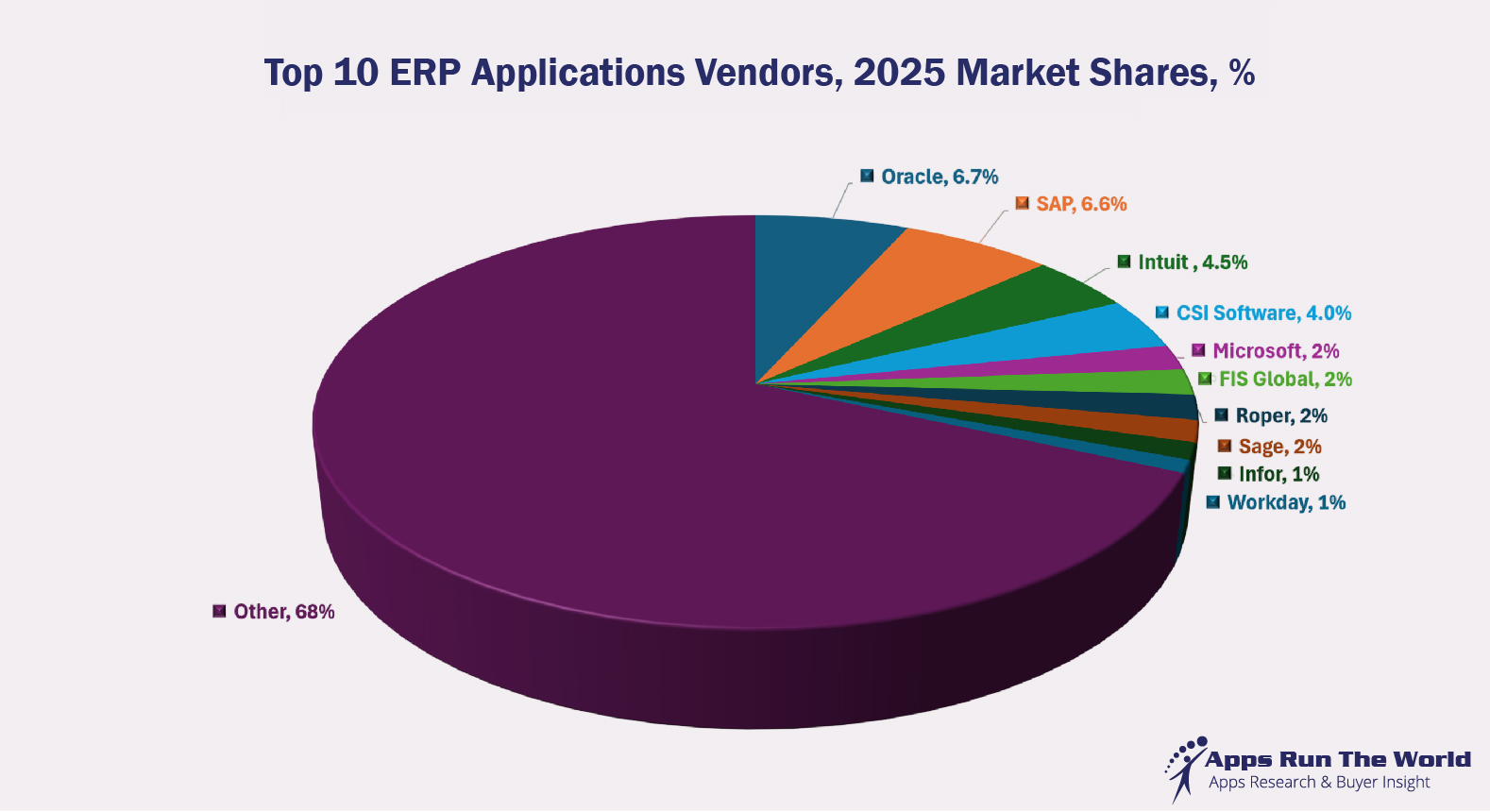
The Enterprise Resource Planning applications market grew 11% to top $146 billion in 2025, picking up additional momentum and defying the myth that the rise of AI could spell the end of enterprise software. All but three of the top 10 ERP applications vendors were able to expand at least 11%, or the market average, last year, as shown in the following exhibit.
Exhibit 1 – Top 10 ERP Applications Vendors Worldwide, Their 2024-2025 Revenues, $M, and 2025 Market Shares, %
| Rank | Vendor | ERP Apps | 2024 ERP Apps Revenues, $M* | 2025 ERP Apps Revenues, $M** | YoY Growth | 2025 ERP Market Share, % |
| 1 | Oracle | Oracle Fusion Cloud ERP, Oracle NetSuite ERP, Cerner | $8,769 | $9,719 | 11% | 6.7% |
| 2 | SAP | SAP S/4HANA, SAP Business ByDesign, SAP Business One | $8,688 | $9,610 | 11% | 6.6% |
| 3 | Intuit | Intuit Quickbooks Online, Intuit Enterprise Suite | $5,686 | $6,497 | 14% | 4.5% |
| 4 | CSI Software | CSI Harris, Jonas, Volaris, Perseus, Topicus, Vela | $5,146 | $5,841 | 14% | 4% |
| 5 | Microsoft | Microsoft Dynamics 365 for Finance and Operations, Microsoft Dynamics 365 Business Central | $2,870 | $3,233 | 13% | 2.2% |
| 6 | FIS Global | FIS Core Banking, FIS GETPAID, FIS Integrated Payables | $2,794 | $2,917 | 4% | 2% |
| 7 | Roper | Deltek CostPoint, Aderant Expert, Vertafore AMS360 | $2,490 | $2,861 | 15% | 2% |
| 8 | Sage | Sage Intacct, Sage X3 | $2,229 | $2,459 | 10% | 1.7% |
| 9 | Infor | Infor CloudSuite Enterprise (Infor LN), Infor CloudSuite Industrial (SyteLine), Infor M3 | $1,864 | $1,900 | 2% | 1.3% |
| 10 | Workday | Workday Financial | $1,234 | $1,422 | 15% | 1% |
| Subtotal | $41,770 | $46,459 | 11% | 31.9% | ||
| Other | $89,873 | $99,123 | 10% | 68.1% | ||
| Total | $131,643 | $145,582 | 11% | 100.0% |
Source: Apps Run The World, August 2026
*ERP Revenues = License + Support & Maintenance + SaaS
** All revenue figures are estimates based on public records, Cloud and Non-Cloud business models in Apps Run The World’s vendor database, and annual survey results including vendor feedback.
Oracle As No. 1 in ERP
Oracle was the No. 1 vendor with $9.7 billion in ERP applications revenues for the second year, following its ascent in recent reporting periods on the collective strength of its Oracle Fusion Cloud ERP, NetSuite ERP and industry-specific ERP solutions for healthcare, construction, retail and other industries.
Consistency has been the key to Oracle’s success with its major ERP applications reporting uninterrupted double-digit growth for more than eight years. Oracle Fusion ERP Cloud and NetSuite ERP reported an average increase of 18% and 15%, respectively, through its five-quarter period covering calendar year 2025.
Both have registered more than $1.1 billion in quarterly revenues in recent three-month periods with Oracle Fusion ERP Cloud serving more than 12,000 customers primarily enterprise accounts, and NetSuite ERP focusing on over 44,000 startups and midmarket customers. Our Buyer Insight Technographics Database shows more than 100,000 additional industry-specific accounts running ERP-equivalent products for functions like provisioning and billing for telcos, core banking for fintech, property management for hotels and revenue cycle management/EHR among hospitals.
Oracle is counting on the use of its ERP applications as the mission control for not just the above tasks, but also the nexus for design, creation and extension of AI agents that scale the automation of an array of processes and workflows by keeping the underlying data secure, recommendations reliable and governance possible since every bit of modeling, reasoning and inferencing will involve Oracle Database and the Oracle Cloud Infrastructure for hosting and platforming.
The fact that Oracle has accomplished the feat with more than 1,000 agents for its Cloud ERP apps as of June 2026 underscores the possibilities of this vertically integrated strategy in the AI era. It also raises the stakes as the amount of capital expenditures required to scale to this level of sophistication is growing drastically in order to meet the insatiable needs of Frontier AI Labs as well as captive enterprise accounts that prefer the synergistic benefits of managing agents on top of their own private data.
SAP As No. 2 in ERP
SAP kept its place as the No. 2 vendor with $9.6 billion in ERP applications revenues as its SAP Autonomous Suite continued to expand its market presence while upgrading its legacy ECC customers to the latest S/4HANA and a full array of integrated offerings like SAP Business AI Platform for connecting to other applications for procurement, HR and Business Data Cloud for third-party data, as well as its latest AI enhancements like digital assistant Joule.
SAP’s core ERP revenues are derived from its recurring revenues of SAP ECC (in the form of maintenance), SAP S/4HANA (both in license and maintenance), as well as SAP S/4HANA Cloud (including its private and public-Cloud ERP, GROW Fast, RISE and similar implementations for strategic verticals like banking and oil and gas). Revenues from SAP Business One for midmarket and SAP Business ByDesign (not available to new clients as of April 2026) are also in the mix. For this study, SAP’s core ERP revenues are part of SAP Autonomous Suite, which covers its ERP applications as well as products from SAP Business AI Platform, SAP Ariba, SAP SuccessFactors and others.
For the past few years, SAP has been making progress in its own transformation journey from an enterprise applications vendor that relied on more than 42% of its revenues from on-premise license and maintenance in 2023 to 27% in the first half of 2026. Meanwhile, its Cloud ERP revenues, which cover most of its Cloud applications for ERP and other functional areas, could double to $24 billion by the end of 2026 from $12 billion in 2023.
Also, it coalesced around its SAP Autonomous Suite strategy to ensure all of its Cloud applications customers, their datasets and business processes would be integrated using a common platform. Then it pivoted to its Business AI strategy by migrating over 34,000 customers to run a host of AI add-ons including Joule agents and chatbots as well as its Business Data Cloud for better data integration and analytics when doing modeling and reasoning work with Frontier AI Labs.
It doubled down on data integration by acquiring Reltio for master data management and Dremio for data lakehouse, enabling the vendor to help customers turn the autonomous enterprise vision into reality.
Nearly 10,000 of its customers are at different stages of adopting RISE, the prerequisite step and template toward migrating from its on-premise environment to SAP Cloud ERP. For the midmarket, SAP is turning to its partners to ensure smooth cloud migration including the use of Joule assistants and other AI extensions for improved summarization and better interaction with SAP solutions or external systems.
Execution remains a work in progress for a well-established vendor like SAP with many moving parts. The July 2026 reshuffling of executives responsible for product and engineering organization left its CEO and COO in charge of AI. While the vendor is expected to make further executive changes, it is fair to say that SAP’s own transformation journey may be far from over.
Intuit As No. 3 in ERP
Intuit, which has staked its reputation as the ERP provider for the rest of us with its QuickBooks franchise, made significant moves as the No. 3 ERP vendor by expanding into adjacent markets after buying GoCo for HR and workforce management as well as Relevvo for sales analytics in 2025.
Famous for its formidable presence in the small business market, Intuit tapped into the midmarket by rolling out Intuit Enterprise Suite in 2024, an all-in-one solution for accounting, AP/AR, workforce management with a fair dose of AI for consolidation, reporting and analytics. A year later, it secured more than 350,000 midmarket customers, primarily through upselling and upgrading of its QuickBooks Online installed base. Requests per day for agent usage across Intuit’s platform have topped 450,000.
The migration has also translated into a 38% jump in its revenues from midmarket accounts, clocking in as much as $27,000 in average selling prices, a multiple of what it was able to achieve by selling QuickBooks Online alone. Key differentiating factors include its affordability, and the majority of IES implementations can be done within 30 days.
Intuit has also bulked up its business customer base to more than 10 million as of its most recent quarter with increased penetration by delivering an array of online services such as payment and payroll processing. Close to nine million of them are paying customers within the Intuit online ecosystem conducting all kinds of transactions from employer services to email marketing. For the past five quarters, that has resulted in sales growth of at least 20% for its QuickBooks Online. In its latest quarter in 2026, QuickBooks Online more than doubled its revenues since the same period in 2022.
As Intuit ventures into multiple market segments through product and service bundles as well as acquisitions, the user experience will be something it has to prioritize. The same applies to its ability to protect its core small business customers not at the expense of selling them services that may not fully address their local or industry-specific requirements. It wasn’t too long ago when Intuit was delivering significant ERP value to tens of thousands of construction companies. Its future may well depend on its ability to retain these customers, which has been a target of a new crop of dedicated products from Procore to Foundation.
CSI Software As No. 4 in ERP
The fourth-ranked ERP vendor Constellation Software, the largest software vendor in Canada, stepped up its acquisition engine by paying $802 million in the fourth quarter of 2025, a record for any of its three-month periods, for stakes in a slew of industry-specific ERP and software products including Sabre in the United States and Asseco in Poland. In the first quarter of 2026, CSI Software kept going by investing $786 million in numerous ERP and software assets.
Among its recent acquisitions are Synchronoss, which sells activation services and cloud storage services for telcos, a 13% stake in Sabre Corp. for its travel industry applications, and a 23% stake in Asseco, one of the largest IT service providers in Poland that also offers 12 different ERP applications to 65,000 customers in Europe, Africa and Latin America.
In addition to Sabre, CSI also bought Derbysoft for connecting suppliers and distributors in the travel industry. The recurring theme of the above transactions harkens back to the playbook of CSI, which has been deeply entrenched in different verticals through hundreds of acquisitions of niche providers for everything from court systems to student management among schools.
The equity investments in vendors like Asseco and Sabre are something new given the size of these operations. Regardless, these investments are no different from its other outright purchases that CSI plans to hold forever, according to its executives.
The likely scenario is that CSI plans to use these stakes as a steppingstone to expand further in target areas such as Eastern Europe and the entire travel industry value chain, something that it has done well in other verticals since 2003.
On the other hand, CSI is keenly aware of the durability of its buy and hold strategy that has fueled its growth for nearly a quarter of a century, especially in the AI era when value of many software companies is under duress. In recent quarters, the vendor has upskilled thousands of developers with the latest AI advances, in addition to bringing in hundreds of its product teams from different operating companies to discuss and formulate its responses to the AI paradigm shift.
Despite the pressures from AI modelers and startups that could erode the vast portfolio of CIS software assets, the vendor has been able to post consistent quarterly organic growth since 2024. Still, when one measures its organic growth through the past seven years without factoring in any acquisitions, its total revenue of $819 million in the first quarter of 2019 would have only risen 18% to $963 million in the first quarter of 2026. Similarly, its annaul revenues in 2019 would have grown 15% during the same period through 2025 had it not done any acquisition. True to CSI’s ravenous appetite for acquisitions, its total revenues have now tripled to $11.5 billion in 2025, compared with $3.5 billion in 2019.
Microsoft As No. 5 in ERP
Microsoft stood at No. 5 in 2025 by reinforcing its migration strategy with systematic nudging and steering its legacy AX, GP, NAV and SL customers to Microsoft Dynamics 365 Business Central and Finance and Operations with solid results. In calendar year 2025, Microsoft Dynamics 365 revenues including those for CRM were up on an average of 19% in US dollar and 18% in constant currency.
Given its investment in OpenAI and its AI ambitions, Microsoft is considered the most aggressive in pushing its AI agents – specifically Copilot- before its enterprise accounts, which receive the AI add-on at no extra charge when migrating to Business Central or Finance and Operations. Appearing at industry conferences over the past year, Microsoft executives have brought up Copilot more than any other product from the vendor.
This comes at a time when Microsoft’s ERP revenues have decelerated from the 34%-plus range in 2018-2019 to about 13% in its latest fiscal 2026, based on modeling work done on top of Microsoft’s disclosure of its Dynamics results through the years. Our estimate is that there are still tens of thousands of Microsoft onpremise ERP in the US and even more outside the country.
The issue is whether the existing or new customers of Microsoft ERP are seeing extra value in their Cloud journey even when Copilot is given away in order to boost utilization. The second issue is how Copilot is being positioned as a universal digital agent at the expense of all other AI tools that its customers may be using, a goal that its executives have acknowledged as overreaching at best.
For the time being, Microsoft 365 Copilot is reaching over 30 million paid seats with an estimated sell-through value of as much as $4 billion. The Productivity and Business Processes division of Microsoft reported $102 billion in its fiscal 2026. That means Copilot is contributing to about 4% of its turnover.
It has taken more than 20 years for Microsoft to build its Dynamics 365 franchise, which covers primarily its ERP and CRM applications in addition to modest contributions from Power Apps. The whole franchise now brings in more than $9 billion in sales in its fiscal 2026.
One scenario calls for Microsoft making Copilot the automatic frontend to its ERP or CRM data, a precursor to synthesize its different applications through one conduit.
Notwithstanding customer choice is at stake, Microsoft’s Copilot-first strategy could also backfire by rendering some of its ERP and CRM software assets obsolete in the future since anything new and innovative from the vendor would be coming through the lenses of Copilot.
Performance of Other Top ERP Vendors
Performance of the other top five vendors was uneven with Roper (No. 7) and Workday (No. 10) outpacing the market as both saw a 15% growth in their ERP revenues last year. Roper benefitted from a mix of industries including legal, insurance and government contractor verticals, while Workday was gaining traction among its HR customers and Enterprise Performance Management and Planning customers that also started standardizing on its Financial Management applications.
The sixth-ranked FIS trailed the market due to its focus on banking and core modernization, product-transition dynamics, and financial services technology spending patterns.
The eighth-ranked Sage posted a 10% rise in its total revenues in FY25 ended September 30, 2025 and it forecasted a 9% organic growth in FY26. Its first-half results ended March 31, 2026, maintained the same outlook. The steady performance suggests that its adaptation to the AI era is a work in progress, while some of its legacy customers are being courted by competitors wanting to take advantage of its shifting priorities.
The ninth-ranked Infor remains the dark horse in the ERP market as it bets heavily on its hosting and AI partnership with AWS, riding on its vested interest in strategic verticals within manufacturing and asset-intensive industries, a formula shaped by its being part of the giant Koch Industries. In other words, Infor has enough room to grow just by winning the captive audience within the $100-billion Koch conglomerate.
Forecast of ERP Applications Market Through 2030
Because of the better-than-expected growth in 2025 and the continuous momentum of a whole host of leading and tier-two ERP vendors, we have raised the market forecast through 2030 to 7.1%, reaching $205 billion, as shown in below exhibit. Last year’s forecast was 4.1% CAGR through 2029.
Worldwide ERP Applications Market Forecast Through 2030 in $M and CAGR%
| 2025 | 2026 | 2027 | 2028 | 2029 | 2030 | CAGR, % | |
|---|---|---|---|---|---|---|---|
| Market Forecast | $145,582 | $157,100 | $167,940 | $179,215 | $190,557 | $204,664 | 7.10% |
Source: Apps Run The World, August 2026
Forecast Assumptions
The ERP market is expected to splinter into two camps throughout the forecast period. First will be those that are tethered to the nuts and bolts of financial management on one end and industry-specific domain expertise on the other, exceling at both in many cases.
For these ERP specialists, AI is a value-add that will reshape their trajectory after decades of amassing considerable enterprise data as well as industry best practices. Implementing AI without trustworthy data and industry know-how as the context would be like a trapeze artist without safety net. It’s fun to watch, but any mistake could be deadly.
The second group will be those that align their transformation journey with the frontier AI labs. Amazon is partnering closely with Anthropic, Microsoft is doing the same with OpenAI albeit with few reservations, Google has its Gemini AI model to offer any ERP provider. For the time being, the value propositions from the frontier AI labs lie with ease of coding, speed of deployment and measurement that is somewhat fuzzy at best.
The real gamechangers will need to master all of the above, enabling the incumbents or new entrants to take advantage of enterprise data, industry domain expertise and any market adjacency that allows them to become even more entrenched than ever in a specific vertical or subvertical.
To better understand the dynamics that are shaping the ERP applications market, one needs to go no further than innovators that have been honing their data, context and adjacency with great alacrity.
McDonald’s doesn’t offer the best-quality hamburgers in the world, but it knows how to master the adjacency – specifically french fries and soda drinks.
Automakers are not selling cars these days, but rather the context – new car smell, safety, screen size, and prestige are among the attributes that car buyers are looking for, rather than a mode of transportation.
Crocs is another example of excelling at data and context, outwitting knockoffs by pitching little doodads that accessorize every single purchase of the foam footwear, thusly resulting in higher margins. Its recent international sales exceeding 30% for a 24-year-old brand that still appeals to the finicky buyers is nothing to sneeze at.
While ERP vendors like SAP and others are snapping up master data management products in order to complement their core ERP offerings, it’s worth noting that what frontier AI labs like Anthropic have to offer for finance users is to help them turbocharge such workflows as streamlining analysis, automating reporting and improving forecast accuracy, something that has been available for most ERP customers for years.
Many customers in our Buyer Insight Technographics Database are experimenting the latest AI advances, but they also realize that speed is not the only litmus test. Any airline would tell you that getting passengers faster doesn’t equate to on-time performance that most travelers would prefer, on par with reliability, predictability and safety.
Going forward, the ERP applications market will be shaped by three guiding principles:
- PE Troubles – The current volatility in the private credit market will put some ERP software vendors at risk because of high debt load accumulated through the years, potentially unraveling a number of players, or even a few market segments for that matter. However, a full-blown shakeout is not likely given the size and diversity of the global ERP market. Following the Dot Com Crash in the 2000s and its eventual recovery, a similar turnaround is not without precedent because of the resiliency of the underlying building blocks that have woven into every fabric of business processes relied upon by tens of millions of organizations around the world.
- AI Threat – Like it or not, the threat from frontier AI labs is real. The issue is whether software vendors, including many that offer ERP solutions, are going to favor agents over their core in hopes of winning the AI Flavor of the Month contest. In an ideal world, the default winners will be those that excel at both. Realistically, one can only handle what one is good at. While one should never put all their eggs in one basket when tackling AI, they probably would be better off focusing on things that Frontier AI Labs are not good at – specifically their mobile limitations and disjointed narratives that are being outsourced to data brokers like Mercor to handle with mixed results.
- Customer Sentiment – The truth remains that customers turn to ERP solutions for their domain expertise. Whether it’s financial management or industry understanding, customers are more than happy to offload those complexities to somebody else. Hence, witness outsourcing industries from BPO, HRO and other body shops that have sprung up over the past decades. AI may change many industries in ways that still need to be measured, but it won’t replace outsourcing, or the software industry for that matter. Again, the explosive growth of data brokers is a manifestation of that. Customers want to share the credit and blame when considering buying an ERP solution because they need to entrust their company data to a third party. In order for ERP vendors to prevail, they must commit themselves to refreshing, sustaining and improving their ability to engage with their customers.
